Pakistan

Reclaiming the legacy of ZA Bukhari

18 October 2011

By Raza Rumi

Defining ‘Pakistani’ culture has been a problematic endeavour right from the inception of the country. Pakistan has straddled between 5,000 years of its ancient past, a thousand of years of Muslim rule in the Indian subcontinent, and the secular, plural reality that exists to date. Few individuals attempted to understand this. And fewer could actually lead the arduous process of articulating and shaping a truly nuanced and composite Pakistani culture. Zulfiqar Ali Bukhari, popularly known as ZA Bukhari, was one such Renaissance man who will always be remembered for his life and works, but more importantly for filling the void, which was created due to the truncation of Indo-Muslim identity in 1947. At the time of Independence, Pakistan was beset by the greatest of its challenges, ie of coming to terms with its past and deciding about its future trajectory, conflicts which remain unresolved despite six decades of fruitless struggles. (more…)

Pakistan’s foreign policy: Escaping India?

17 October 2011

By Raza Rumi:

As Pakistan negotiates with a critical moment of its 64-year-old existence, there is nothing more urgent than to review its foreign policy goals and the assumptions that define them. It is an open secret that the unelected institutions of Pakistan for decades have designed controlled and implemented its foreign policy, often at variance with Pakistan’s own pragmatic self-interest. Such have been the contours of Pakistan’s foreign policy perspective, that the institutional interests of its all-powerful military and the allied intelligence complex dominate the definition and outcome of an imagined “national-interest”. Considering how Pakistan finds itself locked in a battle of nerves with the United States since the strike on Osama bin Laden’s compound in the garrison town of Abottabad, on May 2, 2011, there is perhaps no better time for its elites to review and redefine what passes for foreign policy. (more…)

Some sobering lessons

16 October 2011

By Raza Rumi:

Adecade after the ghastly attacks on the Twin Towers, the world has not changed. It is business as usual: imperial projects, ‘dangerous’ foes and millions of hapless, voiceless people. 9/11 was a reprehensible act perpetrated by a desperate and rogue network whose ideologues had hijacked a faith and its symbolism long before they started to assert their worldview by force.
While most 9/11 perpetrators belonged to the Middle East and its infamous Holy Kingdom, Pakistan emerged as the epicentre of terror in the global imagination and continues to occupy that exalted position. Its neighbourhood has been ransacked and occupied by the liberators and now the war on terror has turned into a contested, essential Pakistani experience. Nearly a million people in Iraq are dead or missing but never mind. It is time for the West to take stock of what happened due to a relentless pursuit of ambition and greed of an unaccountable, omnipotent war industry. (more…)

Disasters, dengue and local government

15 October 2011

By Raza Rumi:

In the past few weeks, the intractable crisis of governance has once again exposed the dysfunctional nature of the Pakistani state, and its inability to grapple with basic issues of citizenship. After all, the guaranteeing of people’s rights and entitlements is the responsibility of the state, which it simply cannot abdicate. In Sindh, 5.3 million people have been affected by flash floods, out of which 250,000 are now homeless. The floods had been predicted earlier but the provincial and federal authorities were shamefully ill-prepared like last year. In Punjab, over 5,000 people are battling against the dengue epidemic and there are indications that it may spread to other parts of the country.

The killings in Karachi have momentarily halted but as hundreds of citizens were butchered for no fault of their own, the politicians indulged in a macabre game of accusing each other of breaking up Pakistan. Pity that the discourse on Karachi came down to Zulfiqar Mirza versus the MQM and seldom did anyone debate the fundamental causes of ethnic conflict, social breakdown and the governance vacuum. The killings have been followed by the inundation of the megalopolis by heavy rains. The civic failures of Karachi and Lahore on drainage and public health have exposed how cities cannot function without effective, accountable local governments. (more…)

When are we going to open our eyes?

14 October 2011

By Raza Rumi

Recent reports quote General Kayani saying that Pakistan-US relations are “good” and were “improving”. These remarks follow hectic parleys between various levels of Pakistani and US officials in the recent weeks. The zealous hyper-nationalists of Pakistan found aplenty in the Urdu press, among the TV anchors and right wing politicians, were surely weakening the case for Pakistan as it struggles to manage internal insurgencies and handle a war on its northwestern front. I recall that Pakistan’s ambassador to the US, Hussain Haqqani had pleaded for reason, not letting emotions override serious business like foreign policy. The security establishments’ engagement with the US counterparts, therefore, is nothing but a ‘realistic’ move to repair ties that need to be repaired. Without a cooperation framework how can Pakistan even think of succeeding to retain its influence in the region?

At a recent seminar in Islamabad, organised by the Centre for Civic Education, a speaker remarked that the most illustrative aspect of Pakistanis resilience was the ability to survive, despite cognitive dissonance. Our civil-military elite have nurtured cognitive dissonance for decades, leading to a widespread disturbance of thinking and perception of reality. Our leader of the opposition in the parliament, who thunders against the US at the drop of a hat, was rattled by a WikiLeaks cable that exposed how his family members were US citizens! He organised a press conference and defended his anti-Americanism. A good psychologist would decipher the language used by the maverick politico and identify how he, not unlike many others, intensely suffers from cognitive dissonance. (more…)

No more escape routes

27 September 2011

Pakistan’s military should review the Taliban rule in Afghanistan and how they were not always the kind of partners and proxies we had envisioned

By Raza Rumi

Our Foreign Minister, Hina Rabbani Khar, has warned the United States that if the accusations against Pakistan continue, the US might lose an ally. This statement comes in the wake of US statements that Pakistan-based Haqqani network has allegedly been involved in recent acts of terrorism in Afghanistan, directly threatening and sabotaging the NATO and US interests.

The US blames the Haqqanis for attacks on the US Embassy and NATO Headquarters in Kabul; for attacks on US troops in Wardak province earlier in September. US Chairman of the Joint Chiefs of Staff, Admiral Mike Mullen has used unprecedented and strong language against Pakistan’s premier spy agency ISI and the security establishment for nurturing proxies. Pakistan-US relations just as they were about to look better are perhaps today at a nadir in the decade old war on terror.

The US Senate Appropriations Committee has passed a bill which makes all US aid to Pakistan tied to cooperating with the US in fighting “the Haqqani network and other terror groups associated with al Qaeda”. On the Pakistani side, a vast majority of Pakistanis support a confrontational policy and shunning “America’s war”. This emotional position needs a realistic reassessment and Pakistan simply should keep its economic interests above everything.

At the same time, we should reflect as to why the Haqqani Network from North Waziristan has been operating across the Durand Line. Sixty years of policy choices have once again brought us to a critical phase today. The United States and its various policy making arms and bodies have diagnosed the key cause of their failure in Afghanistan as Pakistan’s support to the Taliban, especially the Haqqani network that it protects. This is not the first time that the US has complained and thundered about the ‘double-game’ being played by Pakistan’s security establishment. The problem with such a narrative is that it glosses over the monumental follies of US strategists and war machines. (more…)

Hoping for Shahbaz Taseer’s early Recovery

5 September 2011

By Raza Rumi:

I fervently hope that Shahbaz Taseer is back by the time these lines are published. However, the past few days have been distressing to see the Taseer family facing yet another trying phase. The young Taseer was abducted on a busy Lahore road on August 26. His case is not uncommon in a country where kidnapping is becoming a popularstrategy with the state, criminal gangs and militant outfits. Hundreds of Pakistanis are missing across the country for various reasons. Despite the intervention of Superior Courts and pronouncements by the political executive, little progress has been made.

Taseer’s abduction followed the kidnapping of Dr Warren Weinstein, representative of a US consulting firm, J E Austin from his house in an affluent part of Lahore. Dr Weinstein is a 70-year-old man suffering from various ailments and his life is surely in danger. These kidnappings say a lot about the level of policing in the province. A Police Force notorious to suppress citizens especially the poor is obviously ill trained to handle such cases. In fact, the policemishandling of forensic evidence in Shahbaz Taseer’s car — right under the watch of TV cameras — speaks volumes for the incompetence in basic treatment of crime scenes. In the case of Dr Weinstein, as media reports suggest, they may have botched up the recovery process by hasty announcements about his possible location. (more…)

The debate on new provinces in Pakistan

30 August 2011

Since 1977, military or quasi-military governments have ruled Pakistan. The basic tenet of such a governance structure has been centralization and denial of multiple identities that Pakistanis have. Recent reform via the 18th Amendment has opened up a debate on new provinces. Not long ago, division of provinces was a taboo. Not anymore. This by itself is a major victory of the quasi-democratic process since 2008, howsoever flawed and contradictory it might be.

Remember this is a country where the largest federating unit – East Pakistan (Bengal) was denied its due in power and resources leading to the tragic events of 1971. From 1955-1970, ethnic, linguistic and local identities were forcibly negated under the One Unit. After the creation of Bangladesh, the federal debate focused on Punjab versus the rest of Pakistan. Even the elected Prime Minsiter, Zulfiqar Ali Bhutto ordered Army operations in Balochsitan and the North West Frontier Province to quell insurgencies and demands for local autonomy. Zia’s rule (1977-88) was a major setback to the federal project as Sindh was at the receiving end and the smaller provinces were remote-controlled from Islamabad. During the decade of democracy (1988-1999), things improved but only marginally. (more…)

Myth and reality of extremism

29 August 2011

Pakistan needs to undertake research on militancy for effective policymaking

By Raza Rumi:

A recent attempt to understand militancy, “Poverty and Support for Militant Politics: Evidence from Pakistan” (Graeme Blair, C. Christine Fair, Neil Malhotra, Jacob N. Shapiro, 2011), provides us fresh insights into the phenomenon or myth of popular support for militant extremism in Pakistan. Using a sample of urban and rural population and employing inventive techniques, this research is an important document if only Pakistan’s policymakers would ever pay attention to the little evidence that is generated with respect to militancy. It is a sad state of affairs that our national policy institutes and ‘think-tanks’ are yet to undertake such studies even when the state and its agencies have been brutally attacked and over 35,000 Pakistanis have died due to terrorism during the last decade. By no means does this survey provide a definitive account of what is happening in the country. However, in the absence of any other study, its findings are most useful to debate how extremism is taking root in the society.

The survey measured public attitudes towards four important militant groups: Al-Qaeda, the Afghan Taliban, Kashmiri groups (Lashkar-e-Tayyaba, Jaish-e-Muhammad among others) and sectarian groups such as Lashkar-e-Jhangvi and Sipah-e-Sahaba. Contrary to conventional wisdom, the study concludes that the survey participants “were generally negatively inclined toward all four militant organizations” and reinforced what many analysts have said often: “Pakistanis do not have a taste for militants”. However, participants differentiated between the groups. They were more inclined to believe that Kashmiri groups provided public goods like health services, etc., and were much more likely to say that they were fighting for a good cause. Secondly, Pakistanis living in violent parts of the country, e.g. Khyber-Pakhtunkhwa (KPK), strongly disliked these groups probably because they pay a higher price for their actions. (more…)

Can we afford to bypass Jinnah’s Pakistan?

14 August 2011

By Raza Rumi

Published today by Jinnah Institute, Islamabad:

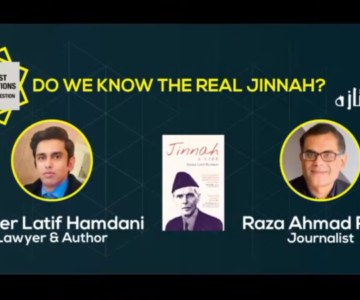
Notwithstanding the contradictions inherent to pre-1947 Muslim politics, Jinnah was clear about certain fundamentals. Pakistan was to be a secular, democratic state. It was not destined to be a national-security obsessed and a paranoid military-intelligence complex.
Pakistan was to be a federation and Jinnah’s advocacy in the 1930s and 1940s was majorly focused on achieving a de-centralized governance paradigm. Finally, the new state was envisioned as a peaceful country, which would interact and establish relations with its neighbour India following the US-Canada model. Jinnah indicated that he would not mind settling down in his native city Bombay after his retirement. All of these facts are on public record and not fantastic or imagined tenets of his vision. What was so alarming about Jinnah’s vision for Pakistan that had to be virtually undone by the custodians of a Praetorian state? Not unlike Pakistan’s history, Jinnah’s legacy is a contested and fractured narrative.

After successive victories, the right wing of Pakistan won a significant battle under General Zia-ul-Haq (1977-1988) when it officially established the “ideology of Pakistan”. However this victory was not limited to official pronouncements but significant institutional changes were also effected to achieve a colonial archetype from South Asian history i.e. a “permanent settlement” of ideological contours. Lord Cornwallis may have undertaken such a settlement for Bengal’s fertile land but Pakistan’s education system, the media and the public discourse finally declared such a settlement as the sacred “truth”.

This sacred “truth” nullified Jinnah’s vision and historic struggles to achieve a fair deal for the Muslims of India, which had culminated in the creation of a truncated and “moth-eaten” Pakistan.

In terms of domestic governance of the new polity, Jinnah’s speeches to civil servants, firm advice to military officers and even to some of his errant politician colleagues were clear. The bureaucracy and the Army had to operate within the legal boundaries and a new direction for the post-colonial state had to be negotiated without undermining the rule of law and the imperative of creating a citizen-responsive state. To the military men Jinnah said the following in June 1948:“…I should like you to study the constitution which is in force in Pakistan at present and understand its true constitutional and legal implications.” And, to the civil service, (more…)

Karachi continues to bleed

3 August 2011

Karachi needs democratisation of power and robust accountability mechanisms

By Raza Rumi:

Karachi’s mayhem in the past few days has exposed, once again, the primary issue of the megapolis — a weak, encroached state. The city has grown in numbers and is now home to millions of Pakistanis of all varieties. Its cosmopolitanism and centrality to Pakistan’s economy means that Pakistan cannot remain unaffected if its largest city is not functioning well.

July has been a bloody month. However, this is not the first time when the city has been subjected to ethnic-bloodbaths. A week ago, the Muttahida Qaumi Movement (MQM) walked out of the federal and provincial governments and this was a signal to all and sundry that the tenuous and uneasy peace between the various power-brokers in Karachi would be affected or at the worst torn asunder.

This is precisely what happened. A strike followed the decision and over 100 people were killed in various low-income settlements comprising mohajirs (migrants), Pakhtuns and others. Public transport remained at a standstill and innocent citizens were targeted by death squads of major political parties which mobilise people around ethnic and linguistic identities. The underlying class-divides among major ethnic groups is also an issue to be explored. The biggest city alas is also the most under-researched region of Pakistan. (more…)

The enigma that is Pakistan (book review)

30 July 2011

By Raza Rumi

Anatol Lieven’s new book is not just a contemporary account of Pakistan, it also attempts to present an alternative narrative of what is often referred to as the worlds most dangerous country. Lieven worked in Pakistan for several years for The Times and is currently a professor of international relations and terrorism at Kings College, London. His approach, therefore, is a curious mix of hard- core research and journalistic reporting. The two intersect, disagree and at times oppose each other.

After exhaustive research and speaking to scores of Pakistanis, Lieven is quite clear that Pakistan does not deserve the oft-repeated verdict of being a failed state or the prediction that it is going to is integrate. He focuses on Pakistans robust society fissiparous and troubled as it is practising the art of resilience as an article of faith.

This is why the author, like many others, is struck by the inherent strengths of Pakistan, which are an antidote to its failures. Lieven also debunks several myths, especially those related to the scary image of Pakistans military-intelligence complex. This is, perhaps, a point of departure in his narrative that makes his work a little unpalatable for hard-nosed Pakistan bashers. Some, in fact, have criticised him for what they see as veiled admiration for Pakistans armed forces. (more…)

The tragic story of Urdu

29 July 2011

By Raza Rumi

What makes translating Urdu literature a rare indulgence has also kept it closeted from global appreciation.

Ralph Russell, the legendary British scholar of Urdu literature, whose tireless efforts to explore the Byzantine layers of Urdu will always serve as a reference point for global Urdu-walas, once summed up the eternal dilemma of achieving a perfect translation of Urdu literature into English. He pointed out that the work of Indian and Pakistani translators suffered from a lack of command in either language. “The English-knowing products of what in India and Pakistan are generally called ‘convent schools’ have acquired their nearly (but not quite) perfect English at the cost of losing full command of their mother tongue,” he wrote in 1996.

This is not to say that translations of Urdu literature have not been accomplished. In fact, there are many 20th century writers whose works have been translated by competent men and women. Key examples are the translations of the short stories of Saadat Hasan Manto and Ismat Chughtai. Their poignant and non-conformist writings have found a wide readership in predominantly English-reading Indian middle classes and western readers attempting to understand the nuances of South Asia’s literary output. The contribution of The Annual of Urdu Studies – edited by Muhammad Umar Memon and published every year from the US – has been immense in this regard. Some writers and poets whose works have been translated include Abdullah Hussein, Patras Bukhari, Shamsur Rahman Faruqi, Rajinder Singh Bedi, Ghulam Abbas, Hajra Masroor, Premchand, Qudratullah Shahab, Intizar whose contribution and devotion to the translation of Urdu literature remains unparalleled and who has provided fine examples of literary translations, leaving out no major contemporary Urdu writer. His academic journal, The Annual of Urdu Studies, continues to publish translated works from Urdu every year.

Literary magazines are a great introduction to young and fresh voices in Urdu. One can observe a constant process of experimentation in language and expression. Short story writer Ali Akbar Natiq, one of Urdu’s most important new voices, and Mohammad Khalid Toor, who is critical newly- rediscovered voice, have been introduced to readers by Urdu literary magazines. (more…)

Regressive governance (book review)

26 July 2011

“…the pasture of stupidity is unwholesome for mankind.”– Ibn-e-Khaldun

 Pakistan’s ‘crisis’ of governance has now acquired an axiomatic status. Local and foreign experts have been grappling with the precise nature of how the Pakistani state has transformed over the past decades. In particular, the state’s inability to turn into a citizen-responsive, accountable entity is a major tragedy of our times. Ilhan Niaz’s award-winning book, The Culture of Power and Governance of Pakistan 1947-2008, is a significant narrative on the philosophical and historical dimensions of governance or lack thereof. Perhaps the most impressive part of his endeavor is the fact that his is an indigenous analysis, emanating very much from a Pakistani scholar who has chosen to rough it out in a public sector university.

The book uses a wide range of declassified records available at the National Documentation Centre in Islamabad and, therefore, posits a fresh perspective on both the political history of Pakistan as well as how the culture of exercising power in South Asia permeated the insular, mock-Weberian state created by the British. In this respect, it is worthwhile to say that Niaz has also ventured into exploring the marked regression of Pakistan’s ruling elites – something that few studies before his have attempted. As he puts it, the state apparatus has over time become arbitrary, proprietary and delusional. (more…)

Towards a decentralised Pakistan

20 July 2011

Without civil service reform, devolution of policy setting will be unachievable and the current reform may just not achieve its intended purposes

On July 1, 2011, the third phase of redistribution of federal powers and functions was completed whereby 7 federal ministries now stand devolved. These include Ministries of Health, Food and Agriculture, Labour and Manpower, Environment, Women Development, Sports and Minorities affairs. Earlier, ten ministries were devolved to the provinces with the abolition of concurrent list under the 18th Amendment.

Implementing the 18th Amendment: The process has been fraught with political bickering between the Centre and the Provinces and resistance by powerful groups, which are beneficiaries of a centralised Pakistan. However, these political and administrative contests have not undermined the process of devolution. A major factor in negotiating this transition has been the role of Mian Raza Rabbani who heads the Implementation Commission for the 18th Amendment to the Constitution.

Most significantly, the political parties have shown their willingness to work together in achieving the intended results of provincial autonomy related clauses. Having said that, the real test of the elected civilian governments has just begun. Large scale restructuring of the federal government and transfer of new functions to the provinces implies that there is much more needed than executive notifications and political rhetoric.

Beyond executive notifications: Four challenges are of urgent importance. First, to ensure that devolution process is completed and not truncated or manipulated to suit the ends of the political parties. At the same time the regulatory capacity of the state, already weakened over decades, must not be diluted during the transition. Secondly, the corresponding institutional capacities are also devolved to the provinces and where missing, the Centre should advise and facilitate institutional strengthening. Thirdly, a civil service reform is required to achieve the responsive and citizen-oriented governance — the larger goal of the 18th Amendment. Finally, decentralisation of provincial powers is also needed and the local government system should be reintroduced. Unpacking and addressing these four imperatives is now an urgent responsibility, which the federal and provincial governments cannot absolve themselves of. (more…)

« Previous PageNext Page »