Sufism

Soul of all souls

26 June 2010
Soul of all souls, life of all life
you are That.
Seen and unseen, moving and unmoving
you are That.
The road that leads to the City is endless;
Go without head or feet
and you’ll already be there.
What else could you be? –
you are that. (more…)

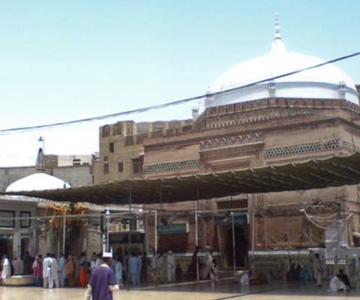
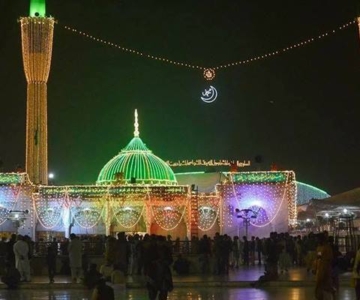
The legend of Shah Ghazi of Karachi

25 June 2010
By Aroosa Masroor (June 20, 2010)
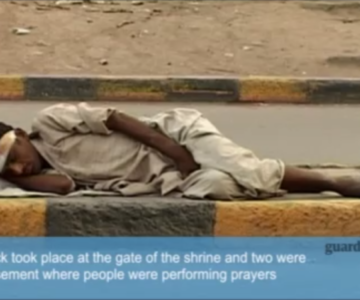
While a good portion of the city’s residents felt compelled to move from the coastline, worried about the destruction Phet might bring, hundreds flocked to Abdullah Shah Ghazi’s shrine with their binoculars as if to challenge the cyclone.
“This place was full of people,” says the shrine’s caretaker Sardar Ahmed, pointing towards the corridor outside the shrine that overlooks Clifton beach. Much to the amusement of these visitors, the cyclone eventually fizzled out, an act most people attribute to the saint’s blessings.
“We knew the cyclone would not strike Karachi. It never has. Only those who have faith in this saint firmly believe this,” says Ahmed, who now refers to the saint as Shehenshah.
He also rubbishes the claim that a wall of the shrine broke due to the high-pressure winds and heavy rainfall on June 5, a night (more…)

You have fallen in love my dear heart

20 June 2010

You have fallen in love my dear heart
Congratulations!

You have freed yourself from all attachments
Congratulations!

You have given up both worlds to be on your own
the whole creation praises your solitude
Congratulations! (more…)

‘Throw Away the Books’ – Bulleh Shah

19 June 2010

Rumi Foundation brings out a ‘Sufi journal’ called Hu. This year two of my essays have been published in the journal. I am posting the first one on Bulleh Shah.

***

If God was found by bathing and cleansing

He would have been found by frogs and fish

If God was found by wandering in the jungles

Stray animals would have found him

O Bulleh, the Lord can only be found

By loving hearts – true and pure…

(Translation by author)

Fifteenth century India witnessed a spiritual-cultural synthesis that was navigated by hundreds of yogis, Sufis and poets of India. Very much a people’s mobilisation, the Bhakti movement articulated a powerful vision of tolerance, amity and co-existence that is still relevant today. The powerful and soulful voices of Sufi poets of the sixteenth century therefore sing a shared tune: of love, rejection of formal identities based on caste, organized religion and class.

Bulleh Shah (1680-1758) of Kasur in Central Punjab is an extraordinary voice that provided a mystical message beyond caste, institutionalized religion and ideologies of power. Born in 1860 and named Abdullah Shah in a Syed family, he found a Murshid (spiritual master) in Shah Inayat who was an Arain (traditionally a non-landowning group). Bulleh’s family disowned him for trampling his caste and therefore identity in the rural context. However, Bulleh Shah, driven by Sufi ideals of equality of humans, rejected the formalized social identity framework based on hierarchies. The quest for knowledge, and the thirst for spiritual completion – what the masses perceive to be the domain of religion – was a pursuit beyond these divisive and hereditary conceptions of formal religion. When the orthodoxy declared him as an infidel, Bulleh replied: (more…)

8th International Mystic Music Sufi Festival

20 April 2010

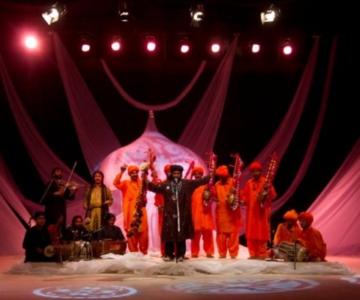
Sufi Music and Expression of Devotion from the Muslim World is one among a rare festival initiated in Pakistan by Rafi Peer Theatre Workshop.Performance Schedule (more…)

Who’s afraid of Dara Shikoh’s ghost?

19 April 2010

Raza Rumi (published in TFT this week)

Madeeha Gauhar
Prince Dara at the feet of his
Sufi saint
Emperor Aurangzeb
Dara Shikoh
Dara reading the Upanishads with Hindu priests
Maulana Maududi
To present a play on a prince who argued – with reason and reference – that there was little difference between the Upanishads and the tenets of mystical Islam is no ordinary feat. After all, this is a country where powerful forces within the state and society are hell bent on turning the Land of the Pure into a haven for cultural fascism
The Ahmedis are hounded on a regular basis, the Shias are being murdered and even the Barelvi majority feels unsafe given the high profile murders of their leadership
The propagation of Islam in the subcontinent was the handiwork of the Sufis who showed the path to a large number of people through the message of tolerance, harmony and reconciliation. Recognising the roots of our indigenous cultures is now the only weapon that Pakistan’s intelligentsia possesses

It is now a given that the Pakistani state is a playground for Islamism and extremism under various guises and forms. Since the passage of the Objectives Resolution in 1949, the state by design and sometimes by default has surrendered to the phantoms of the orthodox Islamic interpretation of the world. It is true that religion was central to the sloganeering for Pakistan, but the post-1947 architecture of the Pakistani state was meant to be secular and democratic. Whatever the proponents and apologists of a jihadi state might have to say, Jinnah’s words and deeds were clear. Iqbal’s vision, inspired by Islamic philosophy and strands of mystical thought, was also clearly anti-Mullah.

This was hardly surprising, as a majority of Indian Muslims, not unlike South Asians of today, were averse to orthodoxy. From the Bhakti movement to folk and Sufi traditions, mullahs and pundits have not enjoyed popular legitimacy, as their alliance with power was resented and rejected by the populace. It is also well known that Mr Maududi and his ilk were bitterly opposed to Pakistan and accused the Muslim League leadership of being un-Islamic. Even stranger is the fact that this essential truth is rarely discussed in the public domain, and excessive coverage and importance given to the orthodox champions of Pakistani nationalism in the media and in textbooks, betrays how the age-old nexus between Pakistani monarchs and the Mullahs has survived the test of time.

Ajoka theatre based in Lahore has been attempting to challenge the status quo. Its plays rooted in the folk and street traditions of the subcontinent have raised political themes and placed political mobilisation at the centre of any discussion for social change. Recently, its play Dara Shikoh was staged in Lahore, and this marked a watershed in our cultural and political landscape. Dara Shikoh, the elder son of Emperor Shahjehan, despite his brutal murder at the hands of his Mullahesque brother Aurangzeb, continues to represent a fault line that runs through the past and the present of South Asia, especially in Pakistan.

To present a play on a prince who argued – with reason and reference – that there was little difference between the Upanishads and the tenets of mystical Islam, is not an ordinary feat in a country where powerful forces within the state and society are hell-bent on turning the Land of the Pure into a haven for cultural fascism. Above all, Dara’s stiff resistance to a militant version of Islam and its exclusionary theological constructs is perhaps most relevant in these times.

However, Ajoka’s effort to take the play to our culturally desertified and politically bankrupt Islamabad, for a presentation at the Pakistan National Council of the Arts (PNCA), has been thwarted by officialdom, as it challenges the state complexion and orientation. One wishes that such a comment were merely speculation, but it seems that there is enough evidence to suggest that a female MNA from the Jamaat-e-Islami wrote to the PNCA earlier. Apparently, she believed that Ajoka was guilty of making fun of Islamic values and represented a threat to the republic of the believers and munafaqeen alike.

How ironic that this is no different from the late 1970s when a senior bureaucrat, now a media personality and scholar (of sorts), authored an article where General Zia ul Haq was compared to the austere and God-fearing Aurangzeb, and Dara was portrayed as a precursor to Zulfiqar Ali Bhutto. The maverick civil servant argued that in the clash of ideology, Zia’s coup was symbolic of religious power. Pakistan suffered from Zia’s assumed divine right to rule in the name of Islam for eleven long years, during which intolerance, bigotry, sectarianism and dictatorship shook the foundations of this country. Intellectual voices and activist groups such as Ajoka have to constantly contend with Zia’s legacy, and the wily servants of the state are always eager to provide legitimacy to retrogression.

Ajoka’s earlier play Burqvaganza explored another explosive subject, that of purdah, and its literal interpretation at the expense of the metaphorical and spiritual meaning. The female MNA referred to above, who also happens to be the daughter of the former Amir of the Jamaat, even raised the issue in the National Assembly and protested that Ajoka’s legitimate questions about the burqa were tantamount to demeaning Islam. History and politics move in cycles, and this outcry in the Parliament was not different from the earlier assaults on the secular vision of Pakistan. All our rulers, except perhaps Ayub Khan, pandered to the orthodox lobby. Under General Zia ul Haq, Islamisation became an official policy and its instruments the un-uniformed part of the national security apparatus.

A small theatre group therefore is pitted against far larger forces of orthodoxy and regressive medievalism. This is shameful, given that an elected government is ruling Pakistan, and the ruling party has been hostile to the ideology of Zia ul Haq. But Zia seems to be alive as much as his nemesis Bhutto. Whilst the jiyalas may chant zinda hai Bhutto, the institutions are pretty smug and happy to articulate zinda hai Zia. Small wonder that JI, whose lack of electoral worth has time and again been exposed, has the audacity to become a guardian of our faith and nationalism.

When Ajoka’s executive director Madeeha Gauhar called the other day to share the recent phase of her ‘struggle’ in the democratic era, she was obviously disturbed. And given her penchant for speaking the truth she was also not too charitable about the Mullah brigade. While she was talking on the phone, her voice faded and a recording of a Hamd (a eulogy for the Almighty) emerged from nowhere. This was amusing, yet quite unnerving. Our Constitution and laws prohibit anyone to monitor citizens’ expression and speech in the public and private spheres. And, to experience this intrusion was not pleasant at all.

Interestingly, the minions of Big Brother played a popular Hamd, that begins with the verse Koi tau haye jo nizam-e-hasti challa raha haye. Muzaffar Warsi, who apparently was Zia ul Haq’s favourite poet, had composed these verses. In view of his special place in the Zia kingdom, he was accorded with various state honours and also a cushy state job. Nusrat Fateh Ali Khan later rendered this piece in his magical voice.

I clearly remember a discussion that took place in the presence of the late Ahmed Nadeem Qasimi, a twentieth century literary giant. Many senior poets critiqued this Hamd for being a problematic hymn for God Almighty, since it did not express absolute belief in God but worked through an inference: there must be Someone who was managing the universe! Thus the element of doubt marred a believer’s chant in praise of his Creator.

More importantly, the bugged phone line sent a clear message: that la-deen (irreligious as secularism is understood by the clerics) Madeeha Gauhar had to be ‘censored’ even in a private conversation, and reminded that there is a God. And, the chosen, self-appointed representatives were managing the show in His name.

This is not limited to the minions of the state apparatus. Such attitudes are now embedded in our curricula, modes of instruction, thousands of madrassas and more dangerously, elements of the media who were trying to convince us of the glories of the Taliban until the Pakistan Army valiantly took on the miscreants.

A journey that commenced with the Right’s struggle to capture political space in the 1940s, and with the state’s cynical support, has culminated in capitulation to such forces. The gradual erosion of Jinnah’s Pakistan has also led to the ascendancy of all that Pakistan was not supposed to represent. The Ahmedis are hounded on a regular basis, the Shias are being murdered, and even the Barelvi majority feels unsafe given the high-profile murders of their leadership. What we have is a curious mix of a Wahabi-Salafi variant of Islamism with several local offshoots, which are not averse to using violence and butchery as weapons.

The propagation of Islam in the subcontinent was the handiwork of Sufis and sages who showed the path to a large number of people through the message of tolerance, harmony and reconciliation. Violence simply did not deliver in this part of the Islamic world.

This is why recognising the roots of our indigenous cultures is important. It is now the only weapon that Pakistan’s intelligentsia possesses. To encourage the airing of alternative messages and interpretations such as Dara’s worldview, and challenging the burqa’s form (more…)

Festival of Lights at Madhu Lal’s Urs, 2010

15 April 2010
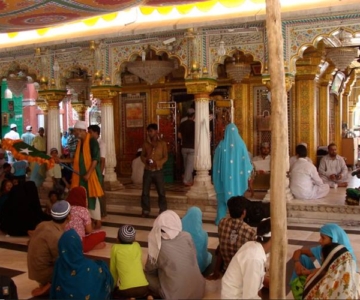
The 3-days Urs of Hazrat Shah Hussain (March 27-29, 2010), radical Sufi saint of Punjab, gained momentum on the weekend as thousands of devotees filled up the narrow streets and the main road leading to the great saint’s shrine while dancing, chanting his poetry and performing spiritual dances.
The entire area around the shrine of Hazrat Shah Hussain and his disciple Madhu, commonly known as Madhu Lal Hussain, continued buzzing with ecstasy amid chants of malangs and devotees who had come over to participate in the Urs from across the country.
Braving the increasing heat, power outages and heavy prices being extorted by transporters and the makeshift shopkeepers, men, women and children immersed themselves in mystic joy while performing the centuries-rituals at the shrine of the saint. The devotees, especially women, flocking the shrine made it a point to light a lamp for the fulfillment of their wishes. This ritual has given the grand festival the name ‘Mela Chiragan’ (The Festival of Lights)

Baba Nanak to Baba Farid

24 March 2010
This is how the Sufis and mystics of South Asia viewed jihad, peace and the role of religion. Surely our extremists need to read and imbibe the message in this fabulous ashlok (verse):
Allah, Farid, juhdi hamesha
Au Shaikh Farid, juhdi Allah Allah.
Acquiring Allah’s grace is the aim of my jihad, 0 Farid!
Come Shaikh Farid! Allah, Allah’s grace alone is ever the aim of my jihad
(Baba Guru Nanak Sahib to Baba Shaikh Farid Sahib)

Abr mi barad-o man shovm-e az yar-e judaa (The cloud weeps…)

13 March 2010

Amir Khusrau’s lofty couplet

Abr mi barad-o man shovm-e az yar-e judaa
Choon kunam dil becheneen roz zedildar judaa.
Abr baraan wa man-o yar satadah ba-widaa
Man judaa girya kunaan, abr judaa, yaar judaa

The cloud weeps, and I become separated from my friend -
How can I separate my heart from my heart’s friend on such a day.
The cloud weeping, and I and the friend standing, bidding farewell -
I weeping separately, the clouds separately, the friend separately..

(trans. A. Schimmel)

Also see this

Nusrat Fateh Ali Khan – Man Kunto Maula

10 March 2010

Lovers have nothing to do with existence

3 March 2010
The lover’s food is the love of the bread;
no bread need be at hand:
no one who is sincere in his love is a slave to existence.
Lovers have nothing to do with existence;
lovers have the interest without the capital.
Without wings they fly around the world;
without hands they carry the polo ball from the field.
That dervish who caught the scent of Reality
used to weave baskets even though his hands had been cut off.
Lovers have pitched their tents in nonexistence;
they are of one quality and one essence, as nonexistence is.
~~~~~~~~~~~~~~~~~~~~~~ (more…)

Magic moments – incredible photos on mysticism

28 February 2010

Today, a magical photographer and a brave journalist Iason Athanasiadis, wrote to me after reading some of my comments in NYT. This is such a small world after all. Iason has also lived in Pakistan and some of his beautiful pictures can be found here (I am posting an image from Pakistan below from his collection). What a treasure it is. I am so grateful that Iason got in touch..

Here is another one from Iran – absolutely stunning… (more…)

I become like a pen

27 February 2010
Ghazal 2530 from the Diwan-e Shams, in a version by Coleman Barks, in translation by Annemarie Schimmel, and in translation by A.J. Arberry:
~~~~~~~~~~~~~~~~~~~~~~~~~~~~~~~~~~~~~~~~~
I become a pen in the Friend’s hand,
tonight writing “say,” tomorrow “ray.”
He trims the pen for fine calligraphy.
The pen says, “I am here, but who am I?”
He blackens the pen’s face.
He wipes it in his hair. He holds it upside down.
Now he begins to use it.
On one sheet he cancels everything.
On another he adds a dangerous conjunction.
The writing depends entirely on the scribe,
who knows how to split the head of the pen.
Galen knows what a patient needs.
The pen cannot speak for itself, or know what
to disapprove of in its own nature.
Whether I say “pen” or “flag”, it is with this wonderful
conscious unconsciousness: the mind unable to include
its own description, composing blindly.
Held in a hand, yet free.
– Version by Coleman Barks
(Based on the translation by A.J. Arberry)
“These Branching Moments”
Copper Beech Press, 1988 (more…)

Mystical Form of Islam Suits Sufis in Pakistan

26 February 2010

A New York Times’ piece where I was quoted.

By SABRINA TAVERNISE- LAHORE, Pakistan — For those who think Pakistan is all hard-liners, all the time, three activities at an annual festival here may come as a surprise.
Thousands of Muslim worshipers paid tribute to the patron saint of this eastern Pakistani city this month by dancing, drumming and smoking pot.
It is not an image one ordinarily associates with Pakistan, a country whose tormented western border region dominates the news. But it is an important part of how Islam is practiced here, a tradition that goes back a thousand years to Islam’s roots in South Asia. (more…)

This thirst in our souls

26 February 2010

No sound of clapping comes from only one hand.
The thirsty man is moaning, “O delicious water!”
The water is calling, “Where is the one who will drink me?”
This thirst in our souls is the magnetism of the Water:
We are Its, and It is ours.

~~~~~~~~~~~~~~~~~~~~~~

Hich bâng-e kaff zadan na-âyad beh dar
az yeki dast to bi dasti degar
Teshneh mi nâlad keh “Ay âb-e govâr”
âb ham nâlad keh “Ku ân âb khvâr”
Jazb-e âbast in `atash dar jân-e mâ
mâ az ân-e U va U ham ân-e mâ

– Mathnawi III: 4397-4399
Version by Camille and Kabir Helminski
“Rumi: Jewels of Remembrance”
Threshold Books, 1996
Persian transliteration courtesy of Yahyá Monastra

« Previous PageNext Page »