Posts Tagged art

GulJee – what was the harm to you if you had lived a little longer!

29 December 2008

Jahane Rumi is priveleged to publish this exclusive piece contributed by Syed Naveed Abbas

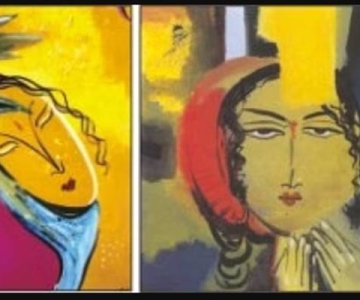
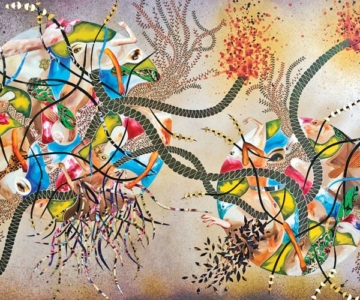
t is the month of December and one’s heart weeps as one invokes the memory of Guljee. His work is a living testament to our times and the dignity of a proud nation. He was the painter from the day he was born. A profoundly earnest and sincere artist, he displayed a high seriousness tempered with tenderness and a love of simplicity. Nevertheless, he is perhaps best known worldwide for his abstract work, which is inspired by Islamic calligraphy and is also influenced by the action painting. The images that Guljee’s brush strokes produced are not only rich in symbolic meaning but visually so much variegated that the eye travels fascinated from point to point. His painting comes from a divine inspiration, giving it a dimension of space and movement. He carried the script with a flourish in all directions, giving it the power of space, vigour and volume. He has made the brush prove mightier than the sword, time and again, and with his brush on canvas he has earned accolades. Whatever Guljee had a hand in turned out to have an unquenchable spark of utter genius. (more…)

Anandi Boiragi – the eclectic painter and an urban Baul

4 September 2008

With legendary artist S.M. Sultan as his mentor, Anadi Kumar Boiragi from Jessore attended Khulna Art College in the late ’80s, before enrolling at the Oriental Department at Charukala in Dhaka to further his artistic education. (more…)

Miniatures make for a commentary on the Sufi spirit

29 August 2008

Nicholas Cranfield considers work that draws deeply on traditional Islamic art

FATIMA ZAHRA HASSAN has been teaching in London for more than a decade, and is an accomplished artist. Dr Hassan’s little show of some 17 works happily fits the commercial gallery in St John’s, Notting Hill, in London, where the blank white walls draw the eye by their rich palette. (more…)

A brush with the new – Asim Butt’s Art

10 July 2008

What distinguishes Asim Butt from his generation and perhaps the preceding generations of artists is the sheer originality of his vision and an iconoclasm that is neither trumpeted nor made visible until the subtext of his lines is closely studied. This is why Asim has undertaken bold strides during the last 10 enriching years of painting. In the meantime, he also earned a degree or two in social sciences, a half-finished PhD at the University of California and formal training from Karachi’s Indus Valley Art school.

Art education in Pakistan, despite its deep- seated tradition of experimentation, does not allow the full exploration of originality. This is why the revival of miniatures has become another soft tool of marketisation and an out-of-wedlock union between art and commercialism. Rejecting what is on the horizon of Pakistani art, Asim Butt has stuck to his innate traumas and nightmares, sometimes indulging them, at others softening them with figures that blend the sensuous with the spiritual and the political with the existential.

his early works display a cracked sense of the self is not surprising. A rebel from his conventional background, Butt continues to defy the conformist meanings of family, career, security, sexuality and that elusive bourgeois pursuit of happiness. Inspired by the Stuckism movement of art, Asim holds painting as a powerful medium of communication. This standpoint brings our young Pakistani Stuckist at odds with the skin-deep novelty and claimed nihilism of “conceptual” art and postmodernism. The pursuit of art in this worldview thus merges into an impulse for a renewal of spiritual values in art and society, or what is known as “re-modernism.” In Asim’s own words: (more…)

An affair with Sufiana art in Ajmer

9 July 2008

My dear friend Salman Chishty is holding an exhibition at the death anniversary (Urs=Union) celebrations of Khawaja Muinuddin Chishty. This is such an innovative tribute to the great Chishty saint. I recall seeing some of these works that he was collecting in Ajmer earlier this year.

This story from the Times of India came as a pleasant surprise …

AJMER: The Sufi message of peace and harmony is being propagated through an exhibition of paintings called ‘Sufi art exhibition’ organized by Salman Chishti, a Sufi Scholar and a curator of art paintings.

He is displaying his collection of 100 paintings on handmade khadi paper at the Chishti Manzil here. The theme of exhibition revolves around calligraphy and paintings depicting Sufi values.

At the exhibition, the Sufi paintings of Najmul Hasan Chishti, a khadim of the Khwaja and a calligraphy artist. The unique feature of this exhibition is the representation of the saying of Sufis in calligraphy, along with its meaning illustrated through a painting in the background.

The principal essence of Najmul’s works is portraying life in ‘Sufi Islam’ and especially on ‘Sama, a form of mediation, widely practiced by the Sufi ‘dervish’. One can observe Rumi poetry in many of his paintings. He had beautifully portrayed the whirling ‘dervishes’ in ecstasy. (more…)

mystical expressionism and Jamali’s art

27 June 2008

Jamali is a contemporary artist of Pakistani origin. It was a delight to have discovered his artistic vision.

Mystical expressionism is a new mode of art-making that combines the scientific insights of our new age with humankind’s ancient wisdom. Obeying the dream guide who set him on the path to art, Jamali himself has named his life’s work Art & Peace.

The source of Jamali’s art and his life lies in the primordial spiritual traditions of the East. In his birthplace Peshawar, the Asian crossroads city, Jamali drank in Buddhist, Hindu, and Sufi ideas of the sacredness of being. He spent years of his youth with a mysterious desert people who still respect the shaman’s powers. But he also studied modern physics and engineering. Jamali is the first to incorporate the paradoxes of quantum mechanics into contemporary art.

Read more here

Hassan Massoudy’s calligraphy: Raza et Rumi

19 June 2008

“The gestures of the calligrapher become an open space, welcoming the words of the poet and the imagination of the onlooker”.

Discovered this image of a calligraphic work and about the Iraqi artist Hassan Massoudy at the JTG Art Blog.

The major part of the compositon is a calligraphic expression of the word “Raza“and interestingly there is a quote by Rumi below with the name Rumi prominently sketched.

Narcisissm or what..I am admiring this image since yesterday and today was compelled to post it here.

About the artist:

Hassan Massoudy is an artist for whom the word itself remains the most sublime creative force. His creations are a subtle mix of present and past, oriental and occidental, tradition and modernity. The words and phrases, which are the inspiration for his calligraphy, are drawn from proverbs, poets and philosophers throughout the centuries, ranging from St. Augustine, Virgil and Ibne Arabi to Baudelaire and Rousseau.

I wonder what is he upto and how have the conditions of Iraq influenced him. Need to find out more. In the meantime, I am glad to have found his works and interact with his brilliance…

More here

The sanctuary

24 April 2008

Nizamuddin’s shrine and the dergah complex is a source of comfort. Each time I have been there, I have felt uncanny sense of comfort and solace. Found this terrific image here -

Ali Kazim – ‘our very own success story’

30 November 2007

“To look at one of Ali Kazim’s paintings is not only to look at something wonderful, something remarkable. It is also to look at something deeply intriguing. Kazim is a fine and highly skilled and accomplished painter, but he is also a deeply compelling and accomplished teller of mysterious and wondrous stories..” (Eddie Chambers in Secret Lives) (more…)

Art as hope – paintings on Southern Thailand

16 October 2007

Pearapong Khireewong is an extremely talented artist who hails from Southern Thailand and has captured the pathos of the bullets that were sprayed on the local populationand later the peace offensive by the now deposed Prime Minister Thaksin.

I was stunned by the light and statements that this canvas made. The painting above is entitled: The Bullet Holes in Narathiwat (Acrylic on canvas , 130 x 150 cm).

Another stunning work is entitled: Monument of the Selfless Heroes (Acrylic on canvas , 120 x 150 cm). Here the light conveys hope and the tidings of the renewal. The paper birds were used to calm the restive provinces. This news-item provides more detail:

“Military aircraft gently bombed southern Thailand with 100 million paper birds Sunday in a gesture intended to promote peace in mainly Muslim provinces where more than 500 people have died this year in attacks by separatist militants and countermeasures by security forces.” (more…)

Meeting Iqbal Hussain in Lahore

17 August 2007

During my recent visit to Lahore, I met the Lahore artist, Iqbal Hussain. We had a nice, engaging chat, saw his recent works some displayed and some eating dust in the splendid Cooco’s Cafe located next to the Badshahi Mosque.

Iqbal’s matter-of-fact portraits have introduced the multiple nuances and shades of Lahore’s red-light area to the world. The women subjects are mostly from the area and he paints them with stark candour and brings out the depths of expressions and emotions in his lines and brush-strokes.

Perhaps the greatest contribution of Iqbal is the establishment of Cooco’s Cafe that has turned into a cultural landmark and has also catalysed urban renewal in the neighbourhood.

Among his recent paintings is the portrait of actor-writer Feryal Ali Gauhar with her dog. This is an uncommon subject but the result is fabulous. I was quick to take a photo (see the image below).

Iqbal is a down-to-earth artist with no pretensions. The directness and simplicity of his work is a reflection of his personality. He braved the mainstream opposition to his paintings with a stoic attitude and has invested his time and soul into the growth of cooco’s as a fine place that offers much more than the old city delicacies and cuisine. I can’t wait to meet him again and see his new work.


Iqbal Hussain – Lahore’s controversial artist

6 February 2007

Iqbal Hussain from Lahore is one of the finest painters we have. Most of his paintings depict women from the Heera Mandi (literally the diamond market)- or the centuries old red-light district. I found the
above image on the Internet today. The news-item referred to Iqbal’s advocacy through his powerful art works:

..Others, who have emerged as spokespersons for the women of Heera Mandi, including leading artist Iqbal Hussain, whose own mother was a sex worker, emphasise their “lack of empowerment, exploitation and helplessness.

His works convey all of these emotions and bring to life extraordinary characters who are often neglected or spurned by the hypocritical culture of Pakistan. (images on the right and below are from here).

More on Iqbal Hussain here.

Endnote from here:

Being termed a controversial painter in Pakistan, Iqbal’s subjects sometimes tend to shock “puritan painters”, but Iqbal follows his own visions and continues to paint his unconventional and radically innovative paintings. He enjoys a great reputation as an artist in the international art world. His paintings have been requested by Jordanian Princess Wijdan Ali for the Jordanian Gallery of Fine Arts. His were the only ones selected for Unesco Headquarters Prize in 1995, Paris. In 1998, one of his paintings was auctioned at the Sotheby’s Auction House in London.

« Previous Page