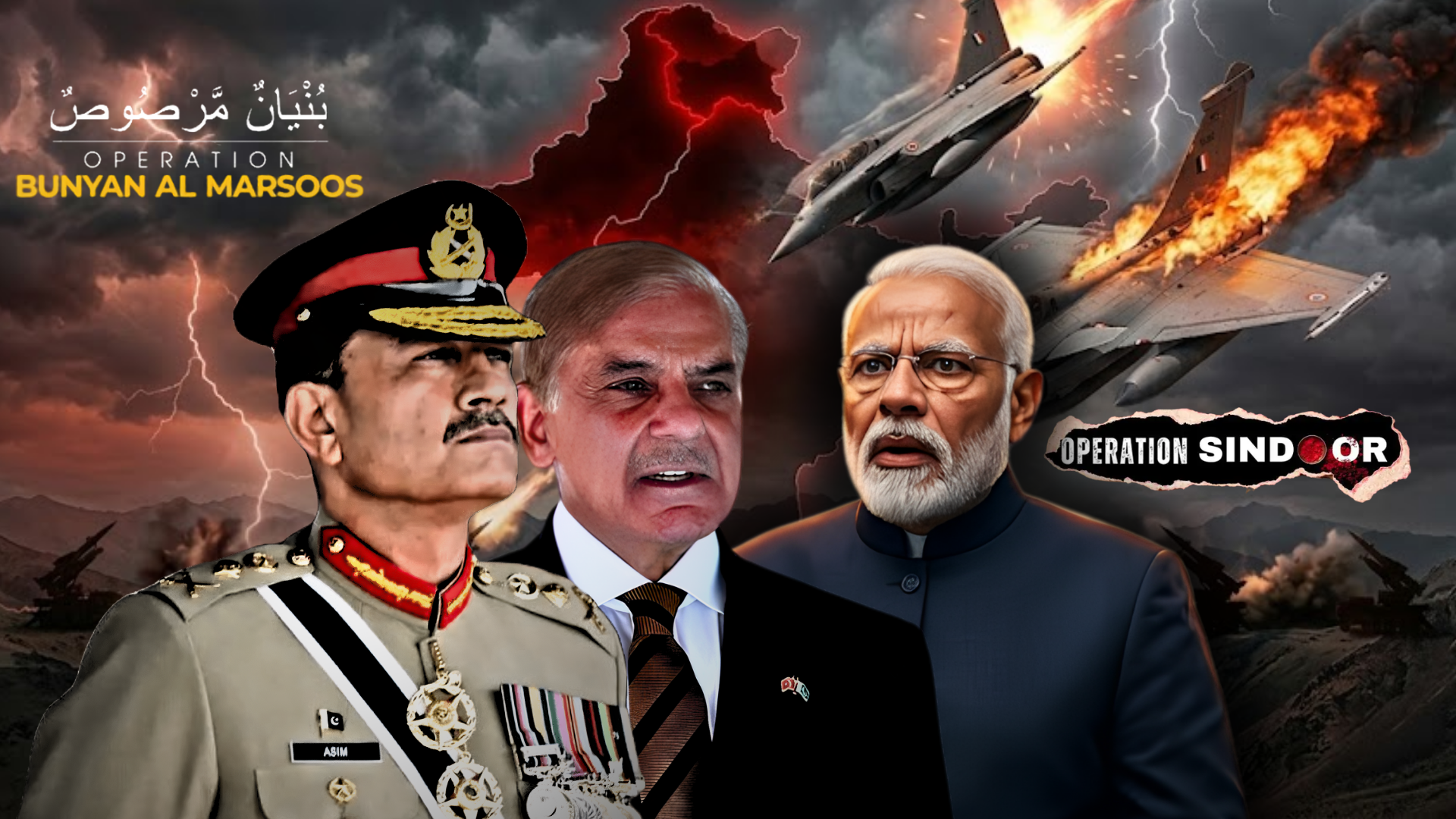
The May 2025 India-Pakistan military confrontation, triggered by Operation Sindoor, has unexpectedly bolstered Pakistan’s strategic position rather than weakening it. While India miscalculated Islamabad’s domestic fragility, diplomatic isolation and lack of external support, Pakistan has gained renewed legitimacy for its army at home, enhanced ties with the United States, and secured new regional clout through a defence pact with Saudi Arabia. Though Pakistan faces economic vulnerabilities and democratic backsliding, the conflict has reset regional equations and marked a turning point in its trajectory.
At least for Pakistan, Operation Sindoor has surprisingly reset the calculus. Earlier, any surgical strikes and incursions into Pakistani territory by India, to target “terror outfits”, did not lead to a full-scale confrontation as happened in the May 2025 conflict. In fact, Pakistan leveraged this opportunity not only to showcase its conventional military capabilities but also to enhance its diplomatic standing vis-à-vis its arch-rival, India.
The India-Pakistan conflict is nothing new; it is an ongoing partition of sorts, where every few years there is either a direct military confrontation, a diplomatic tussle, or an outright breakdown of diplomatic relations. It would be beyond the scope of this article to examine the historical roots and various phases of India-Pakistan relations. However, recent years have witnessed perhaps the lowest point in relations between the neighbours, marked by virtually no diplomatic engagement, no high-level political commitment to achieve normalisation, and, most worryingly, a hostile public opinion that encourages those in power to flex nationalist muscle while corporate media exploits jingoism to boost ratings.
Given the history, Pakistan was the obvious choice to be blamed for the gruesome killings in Pahalgam. Following this, the Indian attack, however, was based on many “miscalculations”.
First, it was assumed that the Pakistan army was unpopular domestically, with strong support for the incarcerated leader Imran Khan, and therefore, strikes would occur at a time when the military was under immense domestic pressure.
The second flawed assumption related to the perceived diplomatic isolation that Pakistan faced in the eyes of the Indian foreign policy community, which had concluded that no one would come to the rescue of its problematic neighbour, given India’s established stature as a regional power.
Third, in calculating the military balance, it was perhaps thought that China would not intervene as in earlier conflicts, and therefore Pakistan would be on the losing side.
Fourth, it was assumed that the United States would remain neutral, if not entirely disengaged, given the Indo-US strategic alliance. There was a basic flaw here: the man at the helm driving US policy is unconventional, and business is not as usual in America.
Lastly, any military confrontation designed to appease or respond to domestic public opinion risks overlooking regional and global complexities.
This is why the post-Operation Sindoor scenario has been a surprise for many in India and even for Pakistanis. In Pakistan, the performance of its armed forces, especially the air force, proved decisive for the fortunes of its generals. Given their inordinate involvement in politics and economic decision-making, a dangerous idea had gained ground: the khakis were not willing or lacked the capacity to fight. Many say that the world noted Pakistan’s performance, and much to India’s protests, the Western media amplified the military losses incurred by the country. Sadly, India’s mainstream media emerged as a greater liability, as its credibility was hit due to misreporting, sensationalism, and over-celebrating studio-based war games. This is partly why the international community was wary of trusting reports from Indian media. Conversely, Pakistan’s military machine did a comparatively better job at peddling its version of events, despite the many questions raised by in-country analysts about the official narrative.
War in the twenty-first century relies on two important variables: information and technology. With respect to the latter, Chinese support to Pakistan was vital in boosting Pakistan’s image, as well as showcasing Chinese defence systems. As one Indian commentator, Pravin Sawhney, has repeatedly stated, India was facing not just Pakistan, but also China—albeit indirectly. This will have repercussions for future Indo-Pakistan conflicts. Needless to say, Chinese declarations guaranteeing Pakistan’s sovereignty were clear indications of the changed regional power balance. One can only hope that Indian strategic planners have read these signals closely.
Perhaps the most surprising outcome was the return of support for the army in its bastion, Punjab, which is also the most populous province and the seat of political and martial power. The fortunes of Pakistan’s Army Chief changed overnight, turning him into a Field Marshal and boosting public trust, as reflected in polls. The law of unintended consequences was at play here: Indian policymakers inadvertently strengthened the position of their arch-rival. The hybrid form of civil-military government in Pakistan is even stronger and receiving international recognition.
India has contested and denied US intervention in brokering a ceasefire. Pakistan, however, has used it as an opportunity. Since May, the trajectory of US-Pakistan relations has seen unprecedented improvement, while India-US relations have been strained due to tariffs, visas and other issues. At the core of this cooling-off phase is that President Trump has not received acknowledgement for stopping a potential nuclear war (in his own words, repeated at least three dozen times). This is once again a direct consequence of what happened in May 2025.
Finally, the hyped image of the Pakistan army has led to greater engagement in the Middle East. The September 2025 Saudi-Pakistan mutual defence pact and Pakistan’s potential role as a net security provider are also linked to the events following Operation Sindoor.
Certainly, all of this poses challenges domestically. First and foremost is Pakistan’s economic situation, which may not leave much room for an expanded defence budget. Pakistan’s policymakers view that as imperative, given that India has only “paused” Operation Sindoor. Second, prospects for full democratic governance have become even slimmer, alarming many political and civil society activists. Third, with increased entanglement in the Middle East, the dangers that lie ahead are unknown. But Pakistan is also confident that Saudi largesse, backed by US investments, might turn the tables. Whether these hopes turn into reality remains to be seen.
Whichever way one looks at it, May 2025 will be seen as a turning point in Pakistan’s trajectory.
(The author is a Pakistani political analyst and editor of The Friday Times and NayaDaur Media. He is also a distinguished lecturer at City University of New York)
First published in Delhi Post