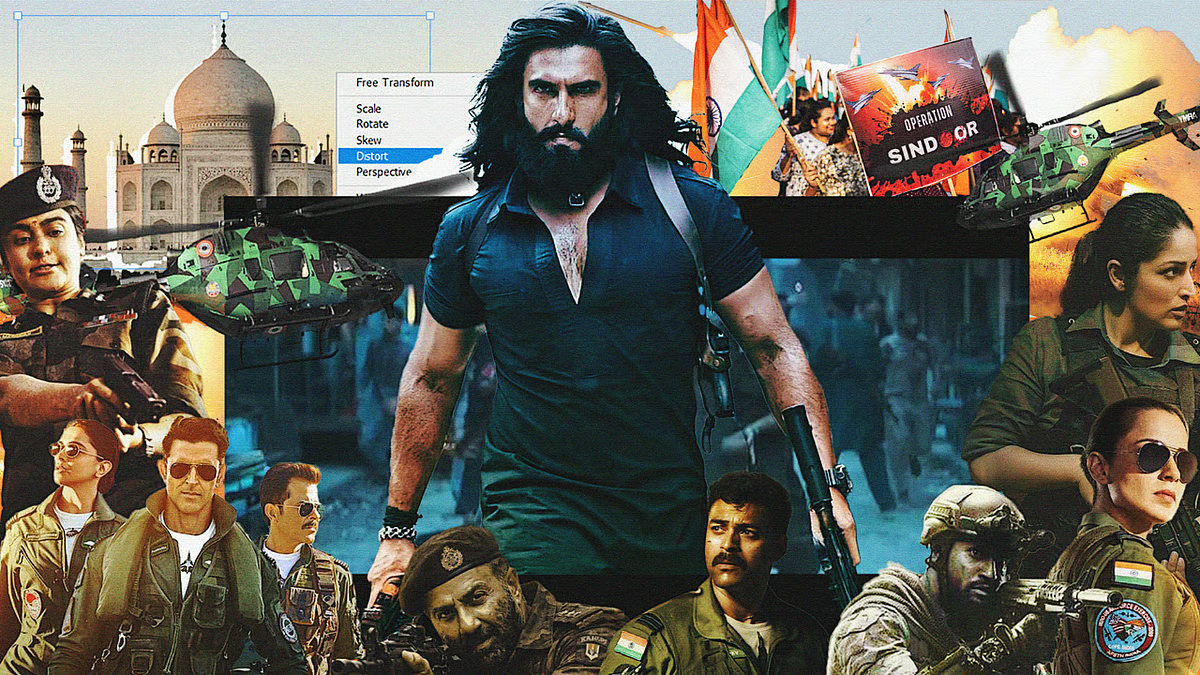
From manufacturing mythic pasts to promoting muscular nationalism, militarism and Islamophobia, Hindi cinema is increasingly aligning with Hindutva politics, and ripping up Indian secularism and democracy in the process.
IF CINEMATIC NARRATIVES have long been intertwined with nationalism and jingoism, contemporary Indian cinema has surpassed earlier precedents. The much-hyped Dhurandhar – the latest Bollywood blockbuster to ignite nationalist sentiment – represents the culmination of a decades-long project to cast Hindu nationalism as the antidote to an unreliable, “terrorist” and inherently evil Pakistan. It is unlikely to be the last such effort – Dhurandhar: The Revenge, a sequel releasing this week, promises more of the same – but it unmistakably crossed the proverbial Rubicon when it comes to cinematic propaganda in India.
Dhurandhar celebrates an incursion of Indian intelligence operatives into Pakistani territory. Specifically, this happens in Lyari – a large, turbulent settlement in Karachi, marked for its large Baloch population as well as its cultural diversity and inclusive atmosphere – where an agent from the Research & Analysis Wing (RAW), India’s external intelligence agency, is ostensibly able to blend seamlessly into the milieu. The Indian operative infiltrates a gang led by Rehman Dakait, a character loosely based on a real-life Lyari gangster of the same name, aiming to destroy the terror infrastructure within Karachi’s underworld. In the process, he falls in love, gets married and ultimately destroys the gang, which is also linked to the notorious 2008 Islamist attacks on Mumbai. The film does not conclusively establish whether this lovestruck Indian spy manages to halt the terror attacks – perhaps leaving that for the forthcoming sequel.
The rise of gangs in Lyari during the 2000s was not merely a criminal phenomenon but closely tied to Karachi’s political and security dynamics. Groups such as the network led by Uzair Baloch, a prominent Lyari gang leader, emerged from local turf battles and extortion rackets but gradually became entangled with political patronage. At various points, analysts and journalists argued that elements within Pakistan’s state and intelligence structures tolerated – or even used – such groups as informal proxies in Karachi’s complex struggles for territorial and political control. The blurred boundaries between crime, politics and the state helped fuel the cycles of violence that marked the city until major security operations after 2013. At the height of the unrest in Karachi, Pakistani authorities often blamed violence in Lyari on the proverbial “Indian hand.” Dhurandhar appears to reinforce that narrative, suggesting that Indian intelligence stoked the ethnic, communal and class-based conflicts that engulfed Karachi.
In this sense, Aditya Dhar, the film’s director, has inadvertently done Pakistan’s establishment a great favour, even if he seemingly aimed to serve the Indian establishment by producing a blockbuster that furthers its preferred narrative while borrowing liberally from real events. The directorial strategy of weaving in actual press clippings, as well as real footage of Karachi, the attacks on Mumbai and the 2001 militant attack on the Indian parliament – even as the film includes a customary disclaimer that its story is fictional – is both clever and insidious: clever as it lends credibility to the narrative and persuades the viewer of its verity; insidious because it plainly recycles and exploits every negative trope in the Indian mind related to Pakistan, Pakistanis and their supposed brethren – India’s huge Muslim minority, which can neither be wished away nor, in the Hindu nationalist imagination, be accepted as equal and full citizens of India.
Numerous critics of Dhurandhar have focused on its factual inaccuracies – its misrepresentation of contemporary Pakistan, the film’s gruesome violence, even small cultural details, such as the fact that most Pakistanis do not use the Urdu honorific mian to address one another as many of the characters do. But the real problem is something deeper: the film’s reduction of Indian nationalism – which once spoke of secularism, equality and freedom – to a violent, masculine and misogynistic interventionism that seeks to “fix” the enemy. Pakistan, it is true, often frames its own nationalist discourse in similar terms, with India on the receiving end. Yet Pakistan, unlike India, does not have nearly eight decades of constitutionalism and pluralistic democratic culture to boast of. This is why, despite its denigration of Pakistan, Dhurandhar is ultimately a slap to India.
THE INTERNATIONAL PROPAGANDA about India’s soft power – its “incredible” beauty and its supposed status as a “vishwaguru”, or global leader, since the rise of Narendra Modi – goes down the gutter when it comes to its neighbourhood. In Southasia, its only imagined mode of engagement, including in propagandistic cinema, is espionage, violence and terrorism in response to alleged terrorism. It is telling that Dhurandhar received rave reviews from mainstream Indian journalists, some of whom deliberately overlooked the misogyny and xenophobia embedded throughout. The film was widely hailed as a technical masterpiece, its excessive violence was acknowledged but excused as being essential to the story. Even Karan Johar, one of Bollywood’s most influential filmmakers, was reportedly “blown away”. Dhurandhar was projected as yet another example of India successfully displaying its power. To interpret as a victory the fictional feat of inserting a spy into a leading Karachi gang is somewhat laughable. The film is rich in propaganda hysterics but short on depicting any concrete triumph.
In its attempt to demonise Pakistan, Dhurandhar ends up cannibalising Indian-ness itself. In one scene, a senior Indian official castigates his own government – then led by the Indian National Congress, the Hindu Right’s main rival for national power – for being soft on terrorism. This echoes the long-standing propaganda of the ruling Bharatiya Janata Party (BJP), which has presented itself as the muscular alternative to what it portrays as Congress weakness, especially when it comes to dealing with an errant Pakistan. There are other such sly references as well. At one point, a high-ranking official, almost a gyani baba – an all-knowing, sage-like figure – predicts that India will one day witness the rise of a leader and a government willing to act decisively against terrorist “infrastructure”. It is obvious that this is supposed to mean Modi and the BJP. This is nothing less than scandalous: a mainstream filmmaker going to shameful lengths to please a regime that has, both at home and beyond, not only struggled to curb violence but also unleashed massive bloodshed itself. Exhibits include: recurring hostilities with Pakistan, explosions of unrest in Indian-administered Kashmir, a state almost of civil war in Manipur, the 2020 pogrom in Delhi, an epidemic of mob attacks on Muslims and Dalits, and more.
In fact, the Modi government’s efficacy in protecting Indian lives is at best doubtful, and its foreign policy is so bankrupt that, a decade after India’s supposed emergence as a “vishwaguru”, almost every one of its neighbours is wary of its hegemonic policies – including Hindu-majority Nepal and even Bangladesh, which owes its 1971 liberation from Pakistan in no small part to aggressive Indian intervention. Perhaps the only exception is Sri Lanka, where perceptions of India are relatively positive, though this could prove tenuous given the troubled history between the two countries.
The brazen partisanship of Dhurandhar does not end with its celebration of the great leader. The film also peddles overt Islamophobia, contributing to the ongoing demonisation not just of Pakistani but also of Indian Muslims, and implicitly legitimising anti-Muslim violence. In one sequence, the film suggests that Inter-Services Intelligence, Pakistan’s foreign spy service, is involved in the printing of fake currency that enters the Indian state of Uttar Pradesh through slaughterhouses, or qasai khaanay. This functions as an Islamophobic dog whistle given the dominance of Muslims in India’s meat trade, and adds fuel to growing calls in much of India to ban animal slaughter and butcher shops, thereby driving Muslim-owned establishments out of business and out of certain neighbourhoods and cities. Haridwar has relocated or shut down most butcher shops; slaughter is banned on particular days and in particular areas in Uttarakhand and Uttar Pradesh, both states under BJP-led state administrations.
Dhurandhar reinforces the insinuation of Indian Muslims being in cahoots with Pakistan via the character of a hardline Indian national security adviser, Ajay Sanyal, who bears an uncanny resemblance to Ajit Doval, the country’s real-life national security adviser. At one point, Sanyal asks his colleagues why the alleged criminal network cannot simply be dismantled. He is told: “Even if we arrest them with evidence, they resort to communal riots.” The reality, however, is starkly different, as documented by international human-rights organisations and independent Indian media that have reported on Hindu nationalists leading anti-Muslim lynchings and mob attacks across the country.
The film, therefore, suggests a nexus between Indian Muslims and Pakistan-sponsored terrorism before mapping this onto Uttar Pradesh, where the narrative’s links between Muslim-run slaughterhouses and a fake currency racket are used to imply that Muslims are responsible for violence and riots that ensue in the state. The irony is that the chief minister of Uttar Pradesh is the right-wing Hindutva fanatic Adityanath, who presents himself as a reformed citizen despite having faced several criminal cases in the past, including on charges related to rioting and promoting communal enmity.
DHURANDHAR builds on earlier attempts to rewrite history while rationalising the rise of muscular Hindu nationalism under Modi and his BJP. As in other domains of the public sphere, cinema has been deftly employed by the Indian state to manufacture consent for a changing imagination of India, one that increasingly shuns the secular project associated with the Indian National Congress since the country’s independence. One prominent example is a series of films presented as “files”, a label meant to lend a false authenticity to the narratives they construct – not unlike the use of real-world footage in Dhurandar.
The director Vivek Agnihotri’s The Kashmir Files (2022) dramatised the displacement of Kashmiri Pandits from the Kashmir Valley in the early 1990s. It arrived just as elections to the legislative assembly of Jammu and Kashmir were being discussed following the dismissal of the state’s elected government and the revocation of its special constitutional status in August 2019. This became a major cultural moment within the broader Hindu nationalist project, which framed these developments as the end of long-standing concessions to India’s only Muslim-majority state. Hindu nationalists emboldened by Modi’s hard line on Kashmir also raised the volume on proposals for demographic change, resettlement and displacement – policies reminiscent of Israel’s treatment of Palestine, which they often cited as inspiration. The Kashmir Files, with its selective retelling of Kashmir’s history and vilification of Kashmiri Muslims, fed the frenzy. The film was made tax-free thanks to special concessions in several states governed by the BJP, a move widely seen as signalling official endorsement.
Another notable project by Aditya Dhar, Article 370 (2024), on which he is credited as writer and producer, navigates similar terrain – espionage, the “Muslim question”, and the status of Kashmir within the Indian nationalist project. The film inserts real incidents into a mix of fiction and cinematic masala that – surprise, surprise – ultimately reinforces the broader narrative of the ruling regime. Once again, the story provides a sweeping justification for the scrapping of Article 370 – the constitutional provision that had granted Jammu and Kashmir special autonomous status until its revocation in 2019. The film frames the move as both a message to Kashmiri separatists and a strong response to Pakistan, which contests India’s claim to the Kashmir Valley, while presenting the BJP-led government as correcting the alleged failures of previous administrations.
Agnihotri’s The Bengal Files (2025), which failed to gain much traction with audiences, was another attempt to rewrite a complex history in keeping with the Hindutva lens. This time the victim was Bengal – particularly, its long-standing secular ethos and caste politics, both of which sit uneasily with the cow-belt vision of India promoted by Hindu nationalists.
Another ambitious cinematic effort to reshape historical narratives on similar lines was Vipul Amrutlal Shah’s The Kerala Story (2023). The film found little resonance with residents of Kerala, a state where the BJP has long struggled to dislodge an entrenched local communist movement and enduring support for the Congress party. The poorly rendered film advanced the idea that Muslim men, working with Pakistan’s terror-sponsoring intelligence agents, were recruiting Indian women to build militant armies in conflict-ridden regions. The trope of “love jihad” remains a favourite theme of the Hindutva movement, and recent cinema has repeatedly reinforced its underlying delusion of a Muslim conspiracy to seduce and convert Hindu women, creating fertile ground for further violence against Muslim men. The release of a sequel to The Kerala Story was temporarily halted by an order of the Kerala High Court following petitions that challenged the film’s veracity and warned of threats to public order.
In this narrative framing, while Muslim men are a “problem”, Muslim women must be liberated – even through coercion or violence – from the supposed clutches of Islamic culture. Another film to advance this view is Suparn Verma’s Haq (2025), based on the infamous Shah Bano case. In 1985, the Supreme Court of India affirmed a divorced Muslim woman’s right to maintenance and thus sparked a political storm during the prime ministerial tenure of the Congress’s Rajiv Gandhi. In response to pressure from conservative Muslim groups, the Congress government at the time tried to appease them by enacting legislation that effectively diluted the judgment and halted attempts to reform Muslim personal law.
Decades later, in 2017, Modi’s BJP government claimed to succeed where the Congress had faltered by outlawing the practice of triple talaq, or instant unilateral divorce, which Muslim personal law had recognised. While many feminists welcomed this as a step towards protecting Muslim women’s rights, others questioned the motives behind the intervention. Was it truly intended to uphold women’s rights in a society where gender violence remains widespread, and where women’s well-being is hardly a national priority except when it comes to stoking notions of Islam’s backwardness? Or was it another attempt to impose Hindu nationalist domination on an already victimised minority, a state-led effort to strip Muslims of their culturally specific legal codes in an attempt to erase Muslim identity within the body politic?
HINDI CINEMA HAS also projected another pillar of the new Indian nationalism: its brute military might and disregard for conventional notions of international law. In a reprehensible 2016 attack, four militants allegedly from Pakistan targeted an Indian Army brigade headquarters in Uri, in Jammu and Kashmir, killing 19 soldiers. The Modi government responded with “surgical strikes” on what it said were terrorist facilities in Pakistan – though both the nature of its chosen targets and the supposed precision of its strikes were widely questioned. A 2019 film by Aditya Dhar, Uri: The Surgical Strike, popularised the Modi government’s doctrine of conducting “surgical strikes” across borders as a legitimate instrument of national defence. Such operations had earlier been carried out in Myanmar too, but it is specifically in relation to Pakistan they have become a recurring feature of state propaganda. Operation Sindoor in 2025, a series of Indian missile strikes on targets in Pakistan and Pakistan-administered Kashmir following a deadly militant attack in Pahalgam, in Indian-administered Kashmir, marked the most recent escalation of this doctrine.
Uri was a massive production and became a box-office hit. The protagonists are portrayed as muscular Indian soldiers seeking revenge for the terror attack, showcasing India’s military superiority over its rival. Unsurprisingly, the film overlooks widely circulated reports that India’s “surgical strikes” hit little more than trees even as the Modi government asserted that it had struck terrorist camps. Uri ends with the prime minister greeting the team of commandos who have supposedly put Pakistan in its place – a fitting conclusion for what is ultimately a work of fiction cloaked in militaristic bravado.
Several other films have tried this dual strategy: the rewriting of history and the celebration of Indian military power. One example is Emergency (2025), a biopic of the former Indian prime minister Indira Gandhi, starring the Bollywood star Kangana Ranaut – the quintessential BJP poster girl and now a minister in the Modi government. Centred on Gandhi’s absolute rule and suspension of democratic rights under a state of emergency in the mid 1970s, the film fetishises military success while simultaneously advancing the BJP’s version of recent history, aligning with familiar critiques of Congress rule and contrasting it implicitly with the decisive leadership claimed by the present regime. By portraying power largely through a binary lens – hero versus villain, order versus chaos – Emergency flattens historical actors into archetypes. Some critics have suggested that its stylisation of centralised authority risks normalising, or even inadvertently glamorising, authoritarian decisiveness rather than offering a layered critique of how democratic institutions can be eroded.
Another biopic, Meghna Gulzar’s Sam Bahadur (2023), glorifies Sam Manekshaw, the military leader who guided India to victory in the 1971 war against Pakistan, which resulted in the creation of Bangladesh. Although less overtly jingoistic in its treatment of its subject, the film nevertheless reads the public mood and reinforces popular, nationalist trust in India’s armed forces.
Ironically, these cinematic projects have emerged at a time when India’s military power has been sharply tested, and been found wanting, by China. During a 2020–2021 border crisis, for instance, Indian troops came out second best against their Chinese counterparts during skirmishes in the Galwan Valley. China has in recent years seized and held pockets of territory that India claims as its own, which Modi and his government have been forced to accept meekly. While the Indian opposition has raised noise over the issue, among the BJP’s supporters and propagandists the muscular nationalism associated with Modi has been notably subdued on this front. A mixture of official obfuscation, denial and distraction remains in force over how the BJP government has allowed Chinese forces to occupy disputed territory without the proportionate military response demanded by many of its critics.
PERCEPTIVE COMMENTATORS might detect another side to all of this: a toxic masculinity that masks a deep vulnerability by wrapping it up in symbols of macho power. This is part and parcel of the muscular nationalism associated with Hindu majoritarian politics. An injured Hindu nationhood – shaped by a narrative of centuries of Muslim conquest and domination – is imagined to require correction through military strength and internal violence to put the Muslims back in their place. Of course, this “correction” also requires the rewriting of history, both to play up Hindu victimhood and to amplify ideas of the Islamic threat.
Mainstream Indian cinema over the past decade or so has actively contributed to the doctoring of ancient and mediaeval pasts. Countless television productions and big-budget films have looked to conjure up a glorious Hindu past supposedly interrupted by the Muslim presence. Sanjay Leela Bhansali’s Padmaavat (2018) epitomised this trend, portraying a heroic Hindu Rajput kingdom that refuses to sacrifice its honour in the face of the threat from a villainous Alauddin Khalji, the 14th-century ruler of the Delhi Sultanate who expanded his power across much of the Subcontinent. The film’s portrayal is historically reductive and misleading; historians have long shown Khalji to be far more complex and mercurial than he appears in Padmaavat. While many commentators celebrated Bhansali’s filmmaking skills, few had the courage to acknowledge that technical brilliance could not absolve him of the massacre of history.
An earlier Bhansali film, Bajirao Mastani (2015), was released soon after Modi’s ascent to national power. The film won several National Film Awards and became a major box-office success. While it highlighted the plight of the Marathas as they were sidelined under the Mughal Empire, Bajirao Mastani also played into the communal passions that afflict present-day India and threaten its secular fabric. Again, a complex history was reduced to a clash of religious identities. The hero, Bajirao – an 18th-century Maratha general and political leader – is portrayed as striving to establish and expand a Hindu empire. The film even contrasts saffron and green flags – imagery that some read as reinforcing religious division, though others interpreted it as symbolising a fusion of Hindu and Muslim pride.
This is not to suggest that historical injustices should be brushed under the carpet, or that a Muslim-centric history should be the only one presented in cinema or literature. But distorting history and fictionalising the past to suit the majoritarian climate of contemporary India is surely a disservice to artistic integrity.
More recently, two films have aligned and coincided with the gradual erasure of Mughal history from the Indian public consciousness, including in school curricula. While the denigration of the Mughal emperors has been an ongoing Hindu nationalist project for decades, the BJP has pushed through significant policy changes on what Indians are taught about their past. Laxman Utekar’s Chhaava (2025) revisits the Maratha struggle against the declining Mughal Empire. Not surprisingly, the film presents a deeply troubling image of Aurangzeb, the 17th-century Mughal emperor who has become the principal historical villain in the minds of the Hindutva brigade.
Chhaava leans heavily into a civilisational and communal framing, casting the Maratha–Mughal conflict in starkly religious terms rather than as a complex struggle shaped by shifting alliances, imperial politics and regional power dynamics. The depiction of Aurangzeb as a singularly malevolent antagonist verges on caricature, emphasising his cruelty and religious intolerance while sidelining the administrative, political and historical nuances of his time, which scholars continue to debate. By dramatising early-modern historical conflict through a polarised Hindu–Muslim lens, the film reinforces contemporary communal anxieties in India, transforming a layered historical contest between rival political powers into a simplified moral battle between religious groups in alignment with present-day identity politics.
There may well be valid reasons to retell the histories of kingdoms and communities that came under pressure during the reign of the Mughal Empire, but such subjects require careful handling. This is so both because of historical fact – for instance, how the Rajputs and other non-Muslim communities aligned themselves with Mughal power – and also because of how deeply imaginations of India’s past shape its complicated present. The release of Chhaava helped inflame anti-Muslim hostility in parts of the country, mirroring the polarising impacts of The Kashmir Files and The Kerala Story. The film provoked Hindutva groups such as the Vishva Hindu Parishad and Bajrang Dal into targeting the tomb of Aurangzeb, in present-day Maharashtra, as a symbol of historical oppression. Devendra Fadnavis, a BJP leader and the chief minister of Maharashtra, publicly blamed the film for contributing to unrest that broke out in the city of Nagpur in early 2025.
Perhaps the most absurd act of historical vandalism so far appeared in The Taj Story (2025), which asserts that the Taj Mahal – the famous 17th-century Mughal mausoleum built by the emperor Shah Jahan – was originally a Hindu temple. It would be pointless to dwell on the film’s hysterical inaccuracies, which risk fuelling further suspicion and discord against Indian Muslims in what is already a deeply hostile environment for them. Such conspiracy theories were once the subject of jokes and ridicule. That they are now being turned into cinematic projects is a sad reflection of what mainstream Indian cinema has come to be.
THERE ARE EXCEPTIONS to this trend, and many artists and filmmakers continue to reject the communal hatred and violence that have engulfed India. Swara Bhaskar, the outspoken actor and activist, and Arundhati Roy, the novelist and political commentator, have spoken against majoritarian politics and democratic erosion, at tangible professional cost. There are other such figures as well. During the years of BJP rule, some notable films have sought to humanise the Muslim community – including, on occasion, Pakistanis as well. They are especially striking when the industry norm has been one of accommodation, if not acquiescence, with the ruling regime, and the film fraternity has largely failed to mount any meaningful challenge to the Hindu nationalism or its methods.
At nearly every opportunity, leading stars of Indian cinema, including prominent actors and directors as well as dynastic power centres such as the Kapoor family – one of Bollywood’s most influential multi-generational film lineages – have openly genuflected before authority. News cycles have been saturated with carefully choreographed selfies of cinema stars with Modi, their private audiences with, and uncritical praise of, the prime minister and other top Hindu nationalist figures. Film stars have also performed heavily publicised pilgrimages to Hindu sites, and a bevy of them attended the grandiose inauguration in 2024 of the Ram Mandir in Ayodhya. The temple, built on the site of a Mughal-era mosque destroyed by a Hindu nationalist mob, signals the death of India’s once-vaunted reputation as Southasia’s secular exception.
Muslim stars, meanwhile, continue to be treated with suspicion by Hindu nationalists despite their achievements, contributions and repeated professions of patriotism. Shah Rukh Khan was effectively “disciplined” through the incarceration of his son on widely disputed charges, while Aamir Khan remains a perennial target of right-wing media outrage. It is only Salman Khan’s conspicuous submission before the vishwaguru – reflected in his attendance at a centenary celebration of the Rashtriya Swayamsevak Sangh, and his increasingly visible embrace of Hindutva symbolism – that appears to have afforded him partial insulation from such attacks.
In other parts of the world – take the United States, or even Iran – prominent stars and artists have spoken out against authoritarian leaders and regimes. Yet in India, which prides itself as the world’s largest democracy, the overwhelming response to all of this is one of brazen silence – from film stars and industry titans, but also from cultural critics and artists at large. This essay not intended as a comparison between India and Pakistan – history is too complicated for easy binaries – yet it is difficult to ignore that even Pakistani artists and intellectuals have often, at crucial moments, spoken out against their authoritarian rulers with a kind of raw courage that comes from living under sometimes unbearable pressure. Perhaps it is because Pakistan’s darkest periods were so stark – martial law, censorship, public floggings, ideological policing – that silence could not easily be disguised. When power announces itself bluntly, dissent becomes a clearer moral imperative. In the face of intensifying majoritarian and identitarian politics in India, and the persistent targeting of minorities such as Christians, Muslims, Sikhs and Dalits, the silence of the creative industries and artists is nothing short of deafening.
In Pakistan, during the years of Muhammad Zia ul-Haq, who governed under martial law from 1977 to 1988, poets recited verses that could land them in prison. Journalists faced bans and intimidation. Theatre practitioners encoded resistance in metaphor. Women marched against discriminatory laws knowing they might be beaten. Faiz Ahmad Faiz, the celebrated Pakistani poet, wrote in criticism of the regime from exile. Habib Jalib, another outspoken dissident poet, recited his work before hostile crowds. The Women’s Action Forum, a feminist collective formed to resist Zia’s Islamisation policies, stood up to a regime determined to redefine citizenship itself. These were not empty gestures; they were choices made under real risk.
This is not to romanticise Pakistan’s trajectory – artistic repression in the country has been real, and the costs have been high. Nor is it to diminish the courage of Indian artists who have spoken out in recent years. There is something about a society repeatedly confronting overt authoritarianism that forges a culture of dissent almost as instinct. When the lines are sharply drawn, artists either retreat or resist.
ULTIMATELY, the question is not which country’s artists are braver. It is whether, in any society, art retains the capacity to unsettle power rather than just flatter it. That is the measure that matters.
In the case of India, rather than protesting the prevailing political climate, filmmakers have increasingly embraced themes that conform neatly to Modi’s self-styled image of muscular, strongman leadership, reflected in his famous boast about having a “56-inch chest”. Sandeep Reddy Vanga’s odious blockbuster Animal (2023) captures the prevailing climate of macho power with unsettling clarity. The film glorifies an arrogant, hyper-violent protagonist, packaging brutality as charisma and masculine exceptionalism. Its Muslim antagonists – most notably Abrar Haque and his clan – are introduced through scenes of ritualised violence, including a notorious wedding massacre where the bloodshed is staged almost operatically. By the film’s climactic confrontation, the conflict is framed less as tragedy than as dynastic cleansing, with the annihilation of Abrar’s lineage presented as a form of cathartic resolution. Rather than interrogating violence, the film aestheticises it, echoing a wider political mood that valorises the settling of grievances through spectacle and force.
Such cinema cultivates a distorted sense of self and nationhood: it normalises communal hatred and sexual violence while asserting the fantasy of invincible, hyper-masculine power.
It would be simplistic to romanticise the pre-Modi era as an age of artistic courage, but there were periods – particularly from the 1970s through to the early 2000s – when both alternative and mainstream cinema more openly interrogated state power, corruption and communal fault lines. Directors such as Shyam Benegal, a pioneer of India’s parallel cinema movement, and Govind Nihalani, a filmmaker known for politically charged social dramas, produced films that confronted uncomfortable realities. Notable examples include Nihalani’s Ardh Satya (1983), a searing portrait of police brutality and systemic rot. Mainstream films also grappled with difficult themes: Bombay (1995) tackled Hindu–Muslim violence in the aftermath of the 1992–1993 riots triggered by the Babri Masjid demolition in Ayodhya; Dil Se.. (1998) engaged, however imperfectly, with insurgency and the psychology of militancy; Rang De Basanti (2006) channelled youth anger against political corruption; and A Wednesday! (2008) dramatised public rage over terrorism while raising unsettling questions about vigilante justice. Even large commercial productions sometimes carried sharper political undertones than we now see.
Those days are gone. Films like Dhurandhar are only the tip of a rapidly growing iceberg – an industry-wide project in which cinema no longer merely reflects Hindu nationalism but actively manufactures it, weaponising myth, grievance and spectacle in the service of power.