terrorism

Is this Jinnah’s Pakistan?

30 May 2010

Published today by Express Tribune

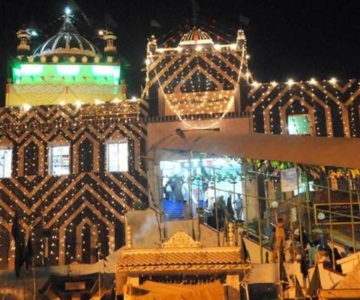
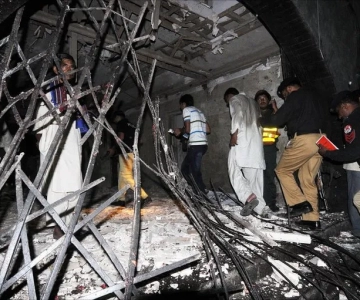
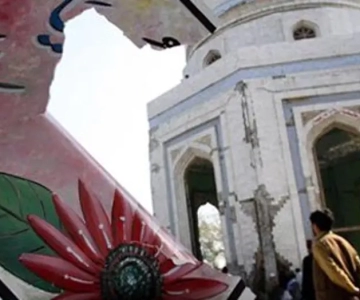
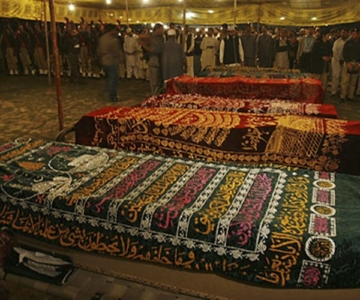
The massacre of Ahmadis in Lahore has once again exposed the inner fissures of our society. As if treating them like second class citizens was not enough, the attacks on their private space of worship has confirmed that militant Islamism is now an embedded reality. Those who have been denying the presence of Punjabi Taliban will have to construct another web of denial and disbelief. We saw signs of that after the fateful tragedy. Instead of constituting investigation teams and ensuring that all necessary leads are collated, senior officials of the Punjab government made a direct reference to RAW, the infamous Indian intelligence agency.

That the terrorists can attack anyone and anywhere is now an established reality. The fact that they chose Lahore and a vulnerable community is a clear message. Indeed, Pakistan as a state should reconsider its goals and strategy of survival. The symbolism of the day chosen for the heinous mass murders is also significant. It was Yaum-i-Takbeer when Pakistan’s atomic prowess was proved on the global stage. Perhaps the greatest delusion of the state’s might and invincibility seems to have been blown to bits. The process of bigotry that started in the 1950s culminated in Zulfikar Bhutto’s tragic action of declaring Ahmadis as non- Muslims in 1974. The Zia years deepened this culture of intolerance. Whilst we may have secured our ‘external defence’ through the much touted nuclear deterrence, internally Pakistan and its hapless citizens are more vulnerable than ever. Fundamentalism is a cancer that has widely spread in the body politic. Yet few wish to tackle it. For the past two years, get-Zardari debates have dominated Pakistan’s public discourse punctuated by the anti-Americanism of the right. The interior minister has been portrayed by the media Taliban as a corrupt nincompoop; and blood thirst for him is evident from the news pages and TV screens. Taliban apologists cannot confront the military establishment directly but the truth is the fight against the Taliban requires political stability and a domestic consensus. The right of Ahmadis to worship and lead a normal life according to the Constitution of Pakistan has been violated. What should a community do when the state and non-state actors are all geared to hound them? Is this Jinnah’s Pakistan? No. (more…)

Lahore – a nightmare that is still not over

29 May 2010

Updated: my quotes in Tehran Times

Today’s events in Lahore have shaken the entire country. The zealots and the bigots aside, an ordinary Pakistani is baffled at the scale and impunity of the violence. A terrorist has been captured – perhaps more as events unfold. But will they be punished or we will find more lame excuses that the Ahmedis by worshipping in their mosques were provoking the believers.

The Taliban want to eliminate all diversity and pluralism from Pakistan. The process alas started in the 1950s and Bhutto’s tragic actions and Zia years have planted bigotry and intolerance. Fundamentalism is now a cancer that has widely spread in the body politic. Yet, no one wants to tackle it. For the past two years, get Zardari debates have dominated Pakistan’s public discourse punctuated by the anti-Americanism of the Right. (more…)

Lahore’s now the latest target of Taliban

29 May 2010

Once again the terrorists have hit Lahore. But this time they have chosen the favourite target of the fundamentalists – the Ahmedis who were declared as non-Muslims in 1974. Two places of worship have been attacked and innocent people have died. This is unacceptable and outrageous. It means that the state policy of exclusion has finally turned the country into a nightmare – a polity where freedom to worship, profess religious orientation and expression is not only curtailed by simply denied.

The resolve of the Government and the Army must be now strengthened after these tragedies. We condemn the state excesses and also the this heinous act of terrorism.

It is almost surreal to see what is happening in Lahore – there is no law and order, no law enforcement worth its name and hapless citizens witnessing the crumbling of a society. It is time to wake up – complacency will not do.

We have to fight terror and the enemy within and not blame the external forces time and again.

As I write these lines, I am petrified as a very dear friend’s father is trapped in the Model Town mosque. may God protect him.

Al-Jazeera: Deaths in Pakistan mosques raids

29 May 2010
The attack sparked a gun battle between security forces and the attackers in Garhi Shahu [AFP]
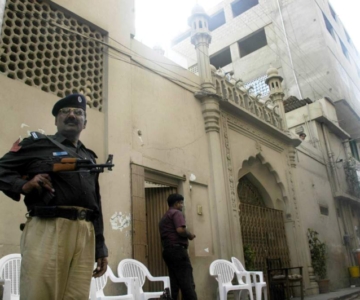
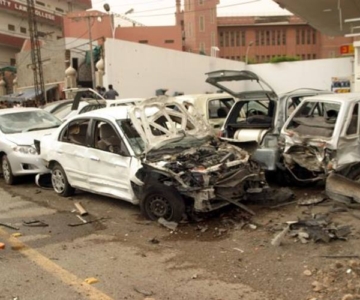
Assailants with guns and grenades have attacked two mosques in the eastern Pakistani city of Lahore, killing at least 80 people.
The co-ordinated assaults on mosques of the minority Ahmadi sect wounded scores more in different residential neighbourhoods of the city shortly after Friday prayers, police said.
The armed men, including three suicide bombers, stormed into the prayer halls firing guns, throwing grenades and reportedly taking hostages, police said.
Sajjad Bhutta, the deputy commissioner of Lahore, said the twin attacks took place on mosques in Garhi Shahu and Model Town. (more…)

Pakistan’s crumbling institutions

25 May 2010

Published in The News (Sunday)

Pakistan’s instability is a cliché, almost a self-fulfilling prophecy. All the theoretical ingredients for stability are there: an elected government, a strengthened Parliament, working relationship between the government and the opposition and above all a free media and an independent judiciary. Despite such a promising milieu, there is chaos, misgovernance and instability all around. The paranoid conspiracy theorists would of course blame the enemies of Pakistan which range from India to Israel and from the United States to the Qadianis. Whilst the astrologers would say that Pakistan was created under a negative cosmic spell. However, the answer to the conundrum of Pakistan’s instability lies in the way its state was fashioned or rather sustained at 1947.

True, the civil-military relationship has been a problem from the very start and using Islamism as a tool for the legitimisation of unaccountable governance. But the fundamental nature of institutions that have wielded and distributed power has remained unchanged for decades. It is only with the assertion of the judiciary and a relatively free media that Pakistan’s political culture is changing and it remains to be seen how long it would be before the ancien regime tries to regain its ascendancy. (more…)

Pakistan’s Southern Punjab: Politics of marginalisation

11 April 2010

The discourse on South Punjab conceals the grassroots social movements and the clamouring for a linguistic identity in the region

The conundrum of South Punjab remains a major challenge for analysts, policy makers and above all the people of this marginalized region. Socio-economic data testifies to the impoverishment and the deprivation that exists in the region. Add to this the iniquitous land distribution and utter lack of economic opportunities for the local population. Despite the rhetoric of the establishment, the region has been neglected through decades of “modern” development in northern and central Punjab. The bulk of public resources were invested in Lahore, Rawalpindi and other urban centers of the North. Industrialisation, growth of private education facilities and the rise of the middle class are phenomena that have eluded the dusty environs of South Punjab.

The result is clear: the electoral patterns show support for redistributive agendas and which are deemed as pro-peasantry. In recent years, southern Punjab has also witnessed two conflictual yet interrelated trends. First, the rise of Islamism through a network of sectarian madrassas which train militants and mercenaries alike; and scattered yet influential social movements around the issues of linguistic identity and livelihoods. How does one make sense of these contradictions? (more…)

A picture that sums up a long story

22 February 2010

Pakistan Taliban commander Hakimullah Mehsud is seen with his arm around Taliban chief Baitullah Mehsud during a news conference in South Waziristan (read more here courtesy this site)

Killing Shias is not jihad – stop this carnage in Pakistan

18 February 2010
This is an old article – When the state kills – authored by Pakistan’s eminent intellectual Khaled Ahmed. It remains relevant for what is happening today – the carnage in Karachi and targetted killing of the Shia minority is a cause for concern for  Pakistanis who want the country to become a plural, tolerant and progressive society for all its citizens irrespective of their faith, caste or creed.
Many of us – who identify themselves as neither Sunni nor Shia (only Muslims) – strongly condemn the Karachi incidents and will continue to raise voice against extremism and sectarianism. (more…)

Muslimness – shifting boundaries

9 February 2010

Muslimness is an elusive state of being. There are watertight strictures of the theological identity defined by men, interpreted as the Sharia, on the one hand; and the broad political and cultural sense of the self, on the other. Identity, in any case, is a messy affair: shifty, shifting and eventually, imagined. While 9/11 placed Muslims at the centre stage of global politics, the broth had already been simmering in the cauldrons of biased academe and pop reality mirrored through the blood-thirsty lens of corporate media.

So what is it to be a Muslim? An inflexible bag of rituals? Or a cultural sense of belonging or a deeper dogma ingrained in young minds? I have never considered myself anything but a believer, a ‘practicing Muslim’. This has never been at variance with my secular and inclusive pretensions, despite the fact that the clergy in my country considers secularism akin to atheism, a sort of mirror image of the Pakistani political foundation. The clerics translate secular as la-deen , at best irreligious, and at worst, godless.

Ironical that this business of religious identity is articulated in a land that was the crucible of the secular Indus Valley civilization, non-militant Buddhism and a peculiar version of South Asian Islam that spread via the Sufi khanqahs and was a sort of amalgam of the Central Asian with the ancient South Asian. Even more ironical is the reality, neglected and veiled, that lived Islam is located around dargahs , tribal codes and customs which are irreligious in their own way. But who cares? Referred to as the world’s most dangerous country, Pakistan, according to the pundits of global opinion, is a haven for Islamic terrorists. Collateral damage, therefore, is kosher and a necessity to undo the unstated part of the ‘axis of evil’.

Labels and more labels. On the global shelves such products sell well and work in favour of a war machine hungry for energy resources, territory and blood. (more…)

To undo the vicious past

4 January 2010

It’s about time a civilian Pakistan functions as a peaceful country with fair share of resources put into people’s welfare by Raza Rumi (published in the News on Sunday)

That Pakistan’s endemic political instability is a function of its inherent power imbalances is well known. The continued spells of authoritarian rule have also retarded the growth of political parties and other necessary institutions essential for democratic governance. We are a country trapped in our history, our self-fulfilling conspiracies and intrigues that are also rooted in the various phases of colonial era. Our geo-political situation, celebrated by a rentier state, has not helped us either. From the 1950s we have been in close partnership with global powers that are viewed as the ultimate saviours of a dysfunctional polity.

In 1971, we lost half the country. While the seeds of discord in East Pakistan had been laid by West Pakistan’s ruling elites, our vengeful neighbour took full advantage and supported the Bangladeshi liberation movement. By all accounts, this was an avoidable tragedy had the national security-obsessed state dominated by West Pakistani vested interests could have seen the writing on the wall and fixed the issues of federalism that still haunt us. (more…)

What is the threat? What is the way out?

16 December 2009

By Raza Rumi (The News on Sunday)

Not unlike good old Nero, who carried on with his self-involved pursuits while Rome burnt, our enlightened brigade from the Urdu and the English medium worlds have been quite busy with their hobbyhorses. With thousands of homes churning out a suicide bomber per minute, the national discourse or the flimsy excuse for it, has been truly remarkable. First came the minus one formula, backed by the ‘be-ghairat’ Kerry Lugar bill and now the centre of universe has shifted to the National Reconciliation Ordinance (NRO).

If one were to follow the trails of verbosity and poisonous write-ups in the print and electronic media, the storyline is as simple as follows: one fine day, late Benazir Bhutto and her ‘corrupt’ husband sitting thousands of miles away from Pakistan issued the NRO to ‘protect’ their wealth. As if these political leaders in exile and wilderness had the legislative and executive authority to issue an Ordinance. (more…)

My Lahore is bleeding again – an eyewitness account

8 December 2009

I am grateful to Khurram Siddiqi for his timely and rather chilling account of what Lahore underwent this evening. Our thoughts and prayers are with the victims of Lahore tragedy. Raza Rumi

Today, two bombs struck Allama Iqbal Town’s ‘Moon Market’- a place that I remember from my childhood when our family used to visit Lahore- many members of which, at the time, lived close to. My cousin Usman was actually at a store in the market when the blast went off, and survived by some miracle. He came home shocked and changed from a full grown man- into a tepid young boy again; he said that he had just witnessed hell itself. I was taking a nap since I’ve been sick over the last few days- and woke to the sound of a cacophony of ambulance sirens; I now live almost across Jinnah Hospital. The bomb went off in Iqbal Town; I’ve tried to illustrate where all of this happened on the map here:
View Moon Market Blasts in a larger map

I walked across to Jinnah Hospital’s emergency ward- not that I condone people amassing together when they shouldn’t be there- but I wanted to capture some of the sounds of the aftermath of mass murder. What you’ll hear in the audio linked below is police officers trying to get people to clear out (I was standing clear of the entrance)- and make way for an ambulance that was about to pull in. Audio Link (more…)

Pakistan’s martial state is a self-perpetuating reality

22 June 2009

The Taliban phenomenon was erroneously, and rather dangerously, projected as a herald of a new dawn

The Pakistani state policy of nurturing jihad factories over the decades is staring back at its architects, supporters and sponsors. Zafar Hilaly, a close aide of the late Benazir Bhutto, recently divulged in his memoirs that BB had confessed how the support to the Taliban was perhaps her most regrettable mistake. She could recognise it was more of a function of being out of the power ambit for nearly a decade. The compulsions of exercising power and playing it by the rules set by the national security obsessed state are perhaps germane to Pakistan’s creation as an insecure postcolonial state that was neither prepared not committed to reverse the colonial modes of governance. (more…)

Literature in the time of terror

19 June 2009

My piece that appeared in The Friday Times (May 29-4 June, 2009 issue). I have argued that the silence of Pakistani writers on terrorism and extremism is finally breaking  


‘Fallen Indus’, a painting by the author


‘Ignorance Is Bliss’, a miniature by Saira Wasim


Since the invasion of Afghanistan by the United States and the global hysteria about ‘terror’ and ‘terrorism’, Pakistan has faced the greatest of existential challenges after its dismemberment in 1971. As a frontline ally of the US in the war on terror, Pakistani society and polity have been engulfed by growing militancy and acts of violence. Whilst there is no single definition of ‘terrorism’, the mainstream media and policymakers – in the service of imperial rhetoric aimed to justify and perpetuate the occupations of Afghanistan and Iraq – have established terrorism as the major threat to domestic and regional peace in South Asia. Acts of premeditated and organised violence in India, Pakistan and Bangladesh have thus assumed a central place in discourse on regional cooperation or its converse: the rivalries between the constructed nation states and their irresponsible power-elites.

 In this milieu, South Asian citizens have been the victims of violence, uncertainty and acrimony that have only led to the exacerbation of poverty, inequality, ascendancy of militarism and the war-mantra. All of this is taking place when globalization is relentlessly seeping into domestic economies, cultures and social systems. Where does this leave the writers and poets of the (more…)

This is a long war

18 June 2009

Published in The NEWS
By Raza Rumi

This is a critical moment in our history perhaps unmatched for its severity and its brutal reality. The experiential nightmare that our country is passing through is perhaps unparalleled for the enemy is neither foreign nor fully identifiable. At the same time, never has there been a clear backing of a military campaign against domestic agents of subversion and anarchy. Forget the doctored samples of opinion polls, often conducted by foreign agencies. That by itself should make us ashamed for our proclivity to accept what others have to analyse and determine for us. Even ignore the fringe voices of dissent led by those who neither have credibility or sagacity to comprehend the existential crisis faced by Pakistan. The army has shown vision and displayed courage in tackling a menace that alas is a home-grown cancer due to our short-sighted strategies in pursuit of phantom depths. The battle to be won is now the country itself.

The political consensus of sorts that has accompanied the military action against the Taliban is also remarkable. Notwithstanding the spin doctors posing as analyst-anchors on the idiot box, the political class has recognised that its survival is embedded in the battle against extremism that predicates itself on elimination of sane, moderate and secular politics itself. This was the Swat model – blow the polity to bits and create a vacuum for a takeover. An age-old recipe employed by the hordes from Central Asia that invaded Muslim Delhi again and again during Sultanate and Mughal periods of our common histories which refuse to be partitioned. (more…)

« Previous PageNext Page »