History

No priests needed – search of a Pakistani identity

27 January 2010

Raza Rumi  wonders why we remain in search of a Pakistani identity

Half-truths are what we love to indulge in. One of the countless crimes committed by President Asif Ali Zardari is that he wears a Sindhi cap instead of a Jinnah cap. That by preferring a Sindhi topi and thundering at the occasion of late Benazir Bhutto’s death anniversary, he undermined his Pakistani identity, is truly mystifying. After all, what is a Pakistani identity and why is the Jinnah cap being elevated to the level of an article of national faith?

If anything, Mr Jinnah’s patronage of Muslim identity mark was an afterthought. His usual attire was a well-tailored pucca-sahib-like suit. It was only in the nineteen forties and that too close to India’s independence that Mr Jinnah started donning the Muslim nobility’s attire.

So what is this fuss all about? Constructing Pakistan’s ideology based on theological interpretation of a universal religion like Islam has been a carefully executed project of the Pakistani establishment and its shadows in the non-state domains. Such cliques have grown bigger, mushroomed and are now essential to our lived reality. Therefore lambasting of Zardari on not sporting a Jinnah cap finds public resonance and broad acceptability within the populous Punjab province where the Urdu press flourishes and finds readers and writers aplenty. (more…)

Saadat Hasan Manto – part II

24 January 2010

After partition of India Saadat Hassan Manto arrived in Lahore sometime in early 1948. In Bombay his friends had tried to stop him from migrating to Pakistan because he was quite popular as a film writer and was making reasonably good money. Among his friends there were top actors and directors of that age—many of them Hindus—who were trying to prevail upon him to forget about migrating. They thought that he would be unhappy in Pakistan because the film industry of Lahore stood badly disrupted with the departure of Hindu film-makers and studio owners. But the law and order situation post-partition of British India was such that many Muslims felt insecure in India, just as many Hindus felt insecure in newly created Pakistan. That was the reason that Manto had already sent his family to Lahore and was keen to join them. Manto and his family were among the millions of Muslims who left present-day India for the newly created Muslim-majority nation of Pakistan. (more…)

URS TODAY-Hazrat Baha-ud-din Zakariya (RA) Multan

21 January 2010

Iftikhar Chaudri’s excellent note on the great saint:
Hazrat Baha-ud-din Zakariya(RA) was a Sufi of Suhrawardiyya order (tariqa). His full name was Al-Sheikh Al-Kabir Sheikh-ul-Islam Baha-ud-Din Abu Muhammad Zakaria Al-Qureshi Al-Asadi Al Hashmi. Sheikh Baha-ud-Din Zakariya known as Bahawal Haq was born at Kot Kehror, a town of Layyah District near Multan, Punjab, Pakistan, around 1170.

His grand father Hazrat Shah Kamaluddin Ali Shah Qureshi al Hashmi arrived Multan from Makkah en route to Khwarizm where he stayed for a short while.In Tariqat he was the disciple of Renowned Sufi Master Shaikh Shahab al-Din Suhrawardi who awarded him Khilafat only after 17 days of stay at his Khanqaah in Baghdaad. (more…)

Maulana Azad’s interview given to Shorish Kashmiri, 1946

27 November 2009

I was intrigued by this interview of Maulana Abul Kalam Azad given to the famous journalist Shorish Kashmiri for a Lahore based Urdu magazine, Chattan, in April 1946. This interesting document has been discovered and translated by a former Indian minister Arif Mohammad Khan. Covert Magazine and newageIslam website have recently published it. The contents of this interview are difficult to agree with. Azad is speaking from a nationalist angle, anti-Pakistan movement platform.

However, the narrative has some interesting observations and predictions for Pakistan that cannot be rubbished simply because Azad was a Congressite. This interview was conducted over a period of two weeks (parallel to the proceedings of the Cabinet Mission) and has not been documented in any book except that of Kashmiri’s book on Abul Kalam Azad, which has been out of print for decades. Its discovery is a welcome step towards better historiography on both sides of the border.

Q: The Hindu Muslim dispute has become so acute that it has foreclosed any possibility of reconciliation. Don’t you think that in this situation the birth of Pakistan has become inevitable? (more…)

Coffee, tea and revolution

15 November 2009

Before his death in July 2009, KK Aziz had accomplished one mission that he had set for himself, i.e. to write about the Lahore Coffee House, the glorious nursery of ideas. Luckily, despite his failing health, Aziz finished a draft that was meant to be a shining part of his autobiographical kaleidoscope. “The Coffee House of Lahore: A Memoir, 1942-57” was published in 2008 and Aziz, in the opening chapters, tells us about the genesis of his passion to document this memorable phase of our contemporary history.

Whenever an intellectual, cultural and literary history of Lahore (or the Punjab and Pakistan) is written, the diverse circles which met and discoursed in the Coffee House will have to be described in detail and the ever-widening waves of their influence recorded. As nothing has been written so far on the subject and I don’t see anything in the offing, I give below a list of the important persons who I can recall.

Quite diligently, Aziz sets forth to list two hundred and six names that would include a wide array of thinkers, scholars, artists, writers and even some CSPs who obviously changed their life course despite the influence of their Coffee House days. For those who want to know about Lahore and its not-so-old diversity, KK Aziz’s memoir is a must-read. It is (more…)

W H Auden on Partition

22 September 2009
A poem by WH Auden (published in 1966) about Radcliffe – I am grateful to KA for this contribution:
Partition
Unbiased at least he was when he arrived on his mission,
Having never set eyes on the land he was called to partition
Between two peoples fanatically at odds,
With their different diets and incompatible gods.
“Time,” they had briefed him in London, “is short. It’s too late
For mutual reconciliation or rational debate:
The only solution now lies in separation.
The Viceroy thinks, as you will see from his letter,
That the less you are seen in his company the better,
So we’ve arranged to provide you with other accommodation.
We can give you four judges, two Moslem and two Hindu,
To consult with, but the final decision must rest with you.”
Shut up in a lonely mansion, with police night and day
Patrolling the gardens to keep the assassins away,
He got down to work, to the task of settling the fate
Of millions. The maps at his disposal were out of date
And the Census Returns almost certainly incorrect,
But there was no time to check them, no time to inspect
Contested areas. The weather was frightfully hot,
And a bout of dysentery kept him constantly on the trot,
But in seven weeks it was done, the frontiers decided,
A continent for better or worse divided.
The next day he sailed for England, where he could quickly forget
The case, as a good lawyer must. Return he would not,
Afraid, as he told his Club, that he might get shot.

Dholavira: A Harappan Metropolis

29 August 2009

Found this interesting post on Shunya

The road to Dholavira goes through a dazzling white landscape of salty mudflats. It is close to noon in early April and the mercury is already past 100F. The desert monotones are interrupted only by the striking attire worn by the women of the nomadic and semi-nomadic pastoral tribes that still inhabit this land: Ahir, Rabari, Jat, Meghwal, and others. When I ask the driver of my hired car to stop for a photo, they receive me with curious stares, hoots, and giggles.

This is the Rann of Kutch, an area about the size of Kuwait, almost entirely within Gujarat and along the border with Pakistan. Once an extension of the Arabian Sea, the Rann (“salt marsh”) has been closed off by centuries of silting. During the monsoons, parts of the Rann fill up with seasonal brackish water, enough for many locals to even harvest shrimp in it. Some abandon their boats on the drying mudflats, presenting a surreal scene for the dry season visitor. Heat mirages abound. Settlement is limited to a few “island” plateaus, one of which, Khadir, hosts the remains of the ancient city of Dholavira, discovered in 1967 and excavated only since 1989.

Entering Khadir, we pass a village and find the only tourist bungalow in town. It hasn’t seen a visitor in three days; I check in and head over to the ruins. I’ve planned this for months; even the hottest hour of the day cannot temper my excitement for the ruins of this 5,000 year-old metropolis of the Indus Valley Civilization. While hundreds of sites have been identified in Gujarat alone, this is among the five biggest known to us in the entire subcontinent, alongside Harappa, Mohanjo-daro, and Ganeriwala in Pakistan, and Rakhigarhi in India. Read more here

Jinnah Unfairly Demonised for Partition

17 August 2009

This report is a welcome step towards understanding our recent history and could have huge implications for the mist that confounds South Asia.RR

LAHORE: Muhammad Ali Jinnah was a “great leader” and was unfairly “demonised” by India for his role in the Partition, Bharatiya Janata Party (BJP) leader Jaswant Singh has said. (more…)

Le grand historien – (KK Aziz 1927-2009)

5 August 2009

Zarina and KK Aziz, Lahore, 2007

KK Aziz, aged 11 years

Author with the grand historian of Pakistan, 2007

KK Aziz, aged 10 years

KK Aziz at MB high school, Batala, 1941-42

KK Aziz at Government College, Lahore, 1946

It was a humid evening in Peshawar when I found out about the demise of Pakistan’s neglected, grand historian KK Aziz. As it is, visiting Peshawar these days is quite depressing, and this news hit me for its stark, brutal reality. This was the physical death of the historian, for the scholar had already been marginalized from the mainstream of an anti-intellectual Pakistan. Only a week before, I had spoken to Zarina Aunty, his wife, and inquired about Aziz’s health. I am overwhelmed by the regret of not having met him for months, knowing full well how fragile he had been for the past few years.

It had become a routine over the years to meet the historian at his Lahore house and spend long, engaging afternoons duly arranged in advance. Aziz was an old-fashioned gentleman: proper, entertaining and hospitable. It was his wife, Zarina, who was more of a light-hearted character in their lonely house full of books and research materials.

At school, our exceptional history teacher had introduced us to KK Aziz and his writings; and the experience of reading shoddy, deceitful textbooks and Aziz’s reasoned critique was both revealing and entertaining. It was years later when my friend Faheem, with whom I explored history, introduced me to K.K. Aziz. That was a fantastic moment, for meeting Aziz was always a mixed experience: exciting, disquieting and sometimes depressing. He peeled away layers and layers of the ignorance and half-truths that have been so viciously grafted on to historiography by Pakistan’s nervous and irresponsible state.

Khursheed Kamal Aziz, commonly known as KK Aziz, was born to Barrister Abdul Aziz, in Ballambour near present-day Faisalabad on December 11, 1927. KK Aziz’s father was acclaimed as “a historian in his own right” for work on Heer Waris Shah, and in the Urdu work “Woh Hawadis Ashna” KK Aziz elucidates his family legacy and his father’s history.

True to his lineage, Aziz was to pen dozens of historical works and there is little doubt that he shall be remembered for generations of academia and independent scholarship. He was an alumnus of Government College, Lahore, where his tutors included Professor Ahmad Shah Patras Bokhari and Professor Sirajuddin. Later, Aziz became a full professor, and over the years taught courses in politics, history, Islamic Studies and Asian studies at various universities in Lahore, Toronto, Cambridge, Heidelberg and Khartoum. His research interests and capacities were emboldened by this international exposure. However, he yearned to bring back his experience and expertise to his country, but each time the co-joined twins of the Pakistani state and its ‘ideology’ were to harry him. Independence in scholarship is not a trait respected by officialdom, for it tends to promote and honour the cop-outs and the conformists.

Aziz served as an Official Historian to the federal government, Chairman of the National Commission on Historical & Cultural Research, and a Special Policy Adviser to the Prime Minister between 1973 and 1978. In these official capacities, he was characteristically important in the historical definition of Pakistan’s ‘life’ as a nation. In 1978, he was heading the National Commission of Historical and Cultural Research in Islamabad when he was forced to leave Pakistan by Zia-ul-Haq.However, this did not dissuade him from his passion and his academic pursuits.

Even before the draconian Zia era, K.K. Aziz faced various impediments from the state. For instance he related to me how the state censored certain portions of Fatima Jinnah’s monograph “My Brother”, where unsavoury remarks about Liaqat Ali Khan were kept under lock and key lest they demolished the official mythologization of Pakistan’s early leadership. Jinnah in Ziarat apparently had refused to see Liaqat Ali Khan, and only on the persuasion of his sister did Jinnah agree to see him, along with Abdur Rab Nishtar. Jinnah reportedly told his sister that the visitors, on the pretext of inquiring after his health, had come to check how soon he was going to die.

Such flagrant abuse of power and distortion of facts has led us to a point where we exist as an imagined fortress of Islam seeking glories, while in reality society and the state are struggling to survive. This is why the exit of KK Aziz is significant, for we have lost the home-grown voice of sanity which gave primacy to facts over spin-doctoring.

Aziz authored “The Pakistani Historian: Pride and Prejudice in the Writing of History” in 1993, elaborating upon the experience from his own professional career and the kind of life that a historian in this country would live through. In the same year he also wrote “The Murder of History”, a succinct rendition on history and how it is presented or obscured by official raconteurs. It was in the 90’s that he also admitted to having ghost-written “The Struggle of Pakistan”, published under the name of Ishtiaq Hussain Qureshi. In 1995 he attended the 62nd anniversary celebration for the name “Pakistan” at an event in London, where he elucidated upon the history of the word “Pakistan”, taking initiation from Rehmat Ali’s declaration “Now or Never” in January 1933. In 1997 he was elected to the coveted Aziz Ahmad Memorial Lectureship at the University of Toronto; signaling his position as a political scientist, as a historian and as an instructor/lecturer of global repute.

The works of KK Aziz testify to his penchant for detail, of verified sources of information and astute analysis. His seminal work, “The Making of Pakistan: A Study in Nationalism”, is a standard textbook and is a superior work on Pakistan’s troubled nationalist identity. His other well-regarded books include “Party Politics in Pakistan 1947-1958”, “History of the Partition of India” and “Britain and Pakistan”, among others. He also authored a diverse range of books that dealt with pre-Partition history: “Public Life in Muslim India: 1850-1947”, “Muslims under Congress Rule 1937-1939: A documentary record”, “British Imperialism in India”, and “The All India Muslim Conference 1928-1935: A documentary record”. His original works on political science and history, such as “Studies in History and Politics” and “Britain and Muslim India” are also well-known. Another well-researched document, “Rahmat Ali: A Biography” was published in 1987, and this is a magnificent tribute to an elusive historical figure who coined the term ‘Pakistan’ in the first instance.

From being an avid nationalist, KK Aziz also journeyed through a phase of disillusionment with the country that he had cherished. I recall a meeting where he was brutally frank about Professor Ishtiaq Hussain Qureshi, who had doctored historical facts to serve the new state, and created a fabricated account of Pakistan’s creation. Even though he had contributed to the writing of the book, Professor Qureshi had tinkered with the truth and set a wrong precedent for coming generations. It is no wonder that historiography in Pakistan is nearly extinct. A handful of Pakistani academics, mostly working in Western universities, such as Ayesha Jalal, are keeping the torch ablaze. But they are condemned and mocked by the guardians of official truth within the country, who cannot view Pakistan’s history beyond the right-wing narratives of anti-Muslim biases of the Hindus. Aziz in his last years was not as firm about his earlier views on the creation of Pakistan, and he did make a few revealing statements that I would rather not quote, for he should now rest in peace and not become a target for self-styled nationalist Mullahs. (more…)

The question of Pakistan’s provincialism

5 July 2009

My piece that appeared in the ‘political economy’ section of The NEWS on Sunday.

The elites drunk on the status quo have expressed two major reactions to the proposal of creating another province within the mighty Punjab. First that this is akin to opening a Pandora’s box when we are at war against terrorism. Second, that this is a planted controversy whereby the ruling PPP wants to harm the house of Raiwind; or a conspiracy by those who want to destabilise Pakistan’s political system.

Both these arguments are spurious for nothing is more important for Pakistan than to make the federation work. The argument that the British drawn provincial boundaries are sacrosanct is as nonsensical as the reality of the Durand Line or for that matter the line of control itself. If anything, South Asia has experienced territorial and demographic shifts through the centuries. When resisted, the sweep of history has blown away the resistant elements and when carefully manoeuvred such shifts have resulted in commonsensical political and administrative solutions. (more…)

Sultana Begum, the great grand daughter-in law of last Mughal emperor

11 May 2009

Jahane Rumi is grateful to Shivnath Jha for this contribution..

Stiching words together to restore glory to the lives lost in oblivion may not be an easy task.
But eminent journalist Shivnath Jha and wife Neena have successfully launched the ‘Andolan Ek Pustak Se’ movement in 2007 to help those who did the country proud in the past. (more…)

The Battle over Hindu History

9 May 2009

Author Wendy Doniger, Professor of the History of Religions, University of Chicago’s Divinity School , writes on this blog about her new work. This new work further consolidates the view that much of the now politically packaged Hinduism was actually a product of colonial scholarship in the ninteenth centruy.

The Battle over Hindu History

For years, some Hindus have argued that the 16th century mosque called the Babri Masjid (after the Mughal emperor Babur) was built over a temple commemorating the birthplace of Rama (an avatar of the god Vishnu) in Ayodhya (the city where, according to the ancient poem called the Ramayana, Rama was born), though there is no evidence whatsoever that there has been ever a temple on that spot or that Rama was born there. (more…)

The Historian – Online Journal of Government College University, Pakistan

23 April 2009

Many months ago I received this link to the online journal of the Government College University, Lahore. It has an impressive editorial board and the editor, Tahir Kamran, is a respected historian whose efforts and contributions to revive the near-dead discipline of history deserve more than appreciation.

The said issue of The Historian has diverse articles including On the Making of Muslims in India Historically and Evolution and Impact of Deobandi Islam in the Punjab. And, there are some brilliant book reviews as well. The book that interested me were Mohsin Hamid’s The Reluctant Fundamentalist, and M.J. AKBAR’s, Blood Brothers: A Family Saga.

I was once a student at this institution albeit for a year only. After years of state control, the recent reforms have improved the quality of instruction and of course the management. Thus the glorious tradition of the Government College shall not wane despite the awful stateof education that haunts Pakistan.

Do visit the website and browse through the pieces if history is your cup of tea.

Saving Kahoo Jo Daro

24 February 2009

Read this impassioned appeal in the press – it also alerted me to the situation that haunts this ancient relic.

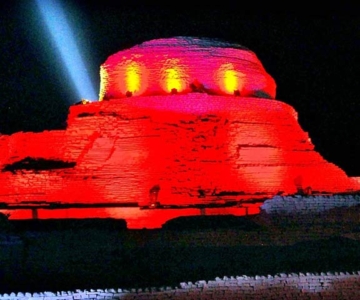
The city is built beside an old Buddhist metropolis of 4th century. There are remnants of the Stupa in ancient city known as Kahoo Jo Daro.

The Stupa on Moen Jo Daro , Kahoo Jo Daro and some other un-excavated Stupas can be classified as the lower Indus basin sites. They are different in art & material. Mud & terracotta is widely used instead of stone. (more…)

Lost Imaginations

9 February 2009

jinnah_with-fatima-and-dina2By Raza Rumi

Sixty one years have gone by but the creation of Pakistan is still a heated debate: contested, fractured and bitter. That history has been the preserve of the victors and the powerful is well known. But to spin and whirl the truth to the extent that it becomes empty and farcical is an art form practiced by the Pakistani state and its mock-historians.
In early January of this new year, a heated controversy entered the public domain. A famous Urdu columnist writing for the largest vernacular newspaper reiterated the widely-known fact that the pragmatic Mr Jinnah had accepted the Cabinet Mission Plan and given up the demand for Pakistan in 1946. However, it was the (more…)

« Previous PageNext Page »