Posts Tagged Taliban

Lahore’s now the latest target of Taliban

29 May 2010

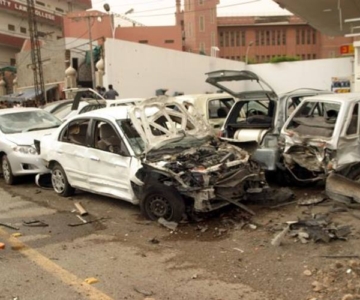
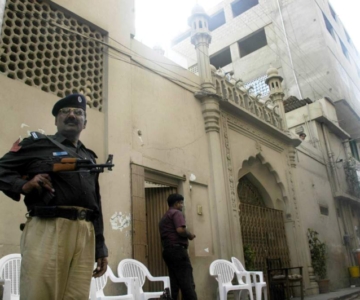
Once again the terrorists have hit Lahore. But this time they have chosen the favourite target of the fundamentalists – the Ahmedis who were declared as non-Muslims in 1974. Two places of worship have been attacked and innocent people have died. This is unacceptable and outrageous. It means that the state policy of exclusion has finally turned the country into a nightmare – a polity where freedom to worship, profess religious orientation and expression is not only curtailed by simply denied.

The resolve of the Government and the Army must be now strengthened after these tragedies. We condemn the state excesses and also the this heinous act of terrorism.

It is almost surreal to see what is happening in Lahore – there is no law and order, no law enforcement worth its name and hapless citizens witnessing the crumbling of a society. It is time to wake up – complacency will not do.

We have to fight terror and the enemy within and not blame the external forces time and again.

As I write these lines, I am petrified as a very dear friend’s father is trapped in the Model Town mosque. may God protect him.

Pakistan’s Southern Punjab: Politics of marginalisation

11 April 2010

The discourse on South Punjab conceals the grassroots social movements and the clamouring for a linguistic identity in the region

The conundrum of South Punjab remains a major challenge for analysts, policy makers and above all the people of this marginalized region. Socio-economic data testifies to the impoverishment and the deprivation that exists in the region. Add to this the iniquitous land distribution and utter lack of economic opportunities for the local population. Despite the rhetoric of the establishment, the region has been neglected through decades of “modern” development in northern and central Punjab. The bulk of public resources were invested in Lahore, Rawalpindi and other urban centers of the North. Industrialisation, growth of private education facilities and the rise of the middle class are phenomena that have eluded the dusty environs of South Punjab.

The result is clear: the electoral patterns show support for redistributive agendas and which are deemed as pro-peasantry. In recent years, southern Punjab has also witnessed two conflictual yet interrelated trends. First, the rise of Islamism through a network of sectarian madrassas which train militants and mercenaries alike; and scattered yet influential social movements around the issues of linguistic identity and livelihoods. How does one make sense of these contradictions? (more…)

Whither civilian governance?

3 April 2010

My new piece published by The Friday Times

While the gurus of security and international affairs continue to unpack and make sense of the high-profile and much-hyped strategic dialogue , the people of Pakistan continue to ask questions about its direct relevance to their lives. If increased US investment in the energy sector and other poverty alleviation programmes would be outcomes of this exercise, perhaps there may be some hope for an ordinary Pakistani. However, it appears that the process of dialogue has harped on familiar tunes, adding to the sound and fury that defines Pak-US relations.

If anything, the re-emergence of the Pakistan Army’s ascendancy over national affairs has been a direct result of the much touted “strategic” dialogue. The Pakistan Army and its leadership have already taken over the foreign policy and recent developments suggest that their command and control over domestic policies of public interest remains as entrenched as ever. Whether this pertains to the meeting of top bureaucrats presided over by the Chief of the Army Staff, or the capitulation of the civilian government before the obsessively India-centric policy of our military-bureaucratic establishment, we are sure about who is calling the shots in the Land of the Pure. (more…)

A picture that sums up a long story

22 February 2010

Pakistan Taliban commander Hakimullah Mehsud is seen with his arm around Taliban chief Baitullah Mehsud during a news conference in South Waziristan (read more here courtesy this site)

To undo the vicious past

4 January 2010

It’s about time a civilian Pakistan functions as a peaceful country with fair share of resources put into people’s welfare by Raza Rumi (published in the News on Sunday)

That Pakistan’s endemic political instability is a function of its inherent power imbalances is well known. The continued spells of authoritarian rule have also retarded the growth of political parties and other necessary institutions essential for democratic governance. We are a country trapped in our history, our self-fulfilling conspiracies and intrigues that are also rooted in the various phases of colonial era. Our geo-political situation, celebrated by a rentier state, has not helped us either. From the 1950s we have been in close partnership with global powers that are viewed as the ultimate saviours of a dysfunctional polity.

In 1971, we lost half the country. While the seeds of discord in East Pakistan had been laid by West Pakistan’s ruling elites, our vengeful neighbour took full advantage and supported the Bangladeshi liberation movement. By all accounts, this was an avoidable tragedy had the national security-obsessed state dominated by West Pakistani vested interests could have seen the writing on the wall and fixed the issues of federalism that still haunt us. (more…)

My Lahore is bleeding again – an eyewitness account

8 December 2009

I am grateful to Khurram Siddiqi for his timely and rather chilling account of what Lahore underwent this evening. Our thoughts and prayers are with the victims of Lahore tragedy. Raza Rumi

Today, two bombs struck Allama Iqbal Town’s ‘Moon Market’- a place that I remember from my childhood when our family used to visit Lahore- many members of which, at the time, lived close to. My cousin Usman was actually at a store in the market when the blast went off, and survived by some miracle. He came home shocked and changed from a full grown man- into a tepid young boy again; he said that he had just witnessed hell itself. I was taking a nap since I’ve been sick over the last few days- and woke to the sound of a cacophony of ambulance sirens; I now live almost across Jinnah Hospital. The bomb went off in Iqbal Town; I’ve tried to illustrate where all of this happened on the map here:
View Moon Market Blasts in a larger map

I walked across to Jinnah Hospital’s emergency ward- not that I condone people amassing together when they shouldn’t be there- but I wanted to capture some of the sounds of the aftermath of mass murder. What you’ll hear in the audio linked below is police officers trying to get people to clear out (I was standing clear of the entrance)- and make way for an ambulance that was about to pull in. Audio Link (more…)

Anchorless rambling

11 November 2009

We did it again. A hallmark of Hillary Clinton’s visit to Pakistan was her meeting with the stars of the Pakistani media – the all-knowing anchors who have taken it upon themselves to be the “representatives” of Pakistan. Forget the President elected by all the legislatures, the Prime Minister who enjoys the confidence of the National Assembly, and even the Foreign Minister, who at the end of the day was elected from a constituency with a huge majority and nominated by the ruling party.

Such constitutional niceties are of little value. What we witnessed with a motley group of top anchors was a repeat of their daily performance on the idiot box, and the discourse with America’s second most powerful politician was familiar and disappointing. A senior journalist based in Lahore remarked that even the young students at the Government College University came up with better questions than the exchanges aired on television.

Who are we? Muslim, South Asian, Arab? No clear answer, because we are ten different things at the same time, and while the rest of the world is comfortable with multiple identities, Punjab’s urban middle classes crave a singular Islamic identity but want it with all the world’s frills. This is why we cheer the blowing up of the World Trade Centre and at the same want to live in New York. This is why the Islamo-fascist hate-America crowd is at ease with their progeny studying in the United States (more…)

Salaam Pakhtunkhwa

25 August 2009

Haligoli, (2001), a miniature by Saira Wasim – collection of
Robert Roder

Peshawar, a city destroyed
by terrorism

IDPs returning to their homes

Wherever I went to eat, there was a meat-fest in waiting. There comes a time in life when you want to give up meat forever and that moment arrived on a dark, load-shedded night in Peshawar

My piece published in The Friday Times (August 21 issue)—–
My recent weeks have been consumed by travels to the capital and to the grim frontiers of Paktunkhwa. As part of an unwieldy team undertaking a survey of the wretched internally displaced persons returning to their homes, I was in and out of Peshawar several times. Other than encountering the depressing stories of a people trapped by their history and geopolitics one had to struggle for a vegetarian meal in good old Peshawar. Wherever I went to eat, there was a meat-fest in waiting. There comes a time in life when you want to give up meat forever and that moment arrived on a dark, load-shedded night in a cloistered guest-house reeking of cigarette-smoke and untreated sewage. Thank God for my friend Ahsan, who like a good comrade humoured me and regurgitated the lessons of being patient and calm. I must not complain too much for I’m not an ungrateful wretch. There are many in the subcontinent who cannot even afford a basic meal, let alone pleasures of the flesh. But there has to be a limit to the carnivorous instinct that we are so given to in the Land of the Pure, Purists and Puritans.

As if a non-vegetarian diet was not enough, the scare of being smoked out by the Al-Qaeda goons was even more disturbing, dare I say, indigestible. A happy-go-lucky and overly-healthy host, as he drove us into the by-lanes of the old Peshawar that must have been beautiful once, gregariously referred to all the sites where bombs had erupted were a little disturbing. Not that I am scared of dangerous places, for I have braved a post-war Kosovo with a fair measure of bravado. But the hysterical “outsiders” ranting about how insecure we were in Peshawar was a little dampening for a Lahori soul. We do live in interesting times, made even more interesting by naïve security experts and people fed on Western media reporting on Pakistan being a truly dangerous pit-hole of the world. Sometimes the propaganda war does conquer your senses, I must confess.

So we visited the camps where thousands had been packed like sardines and where women recounted stories of bereavement and heavy-duty terror-mongering by the good Taliban as we are told that there is a clear distinction between the good and the bad Taliban. Now if the good Taliban, referred to as “patriots” not long ago, are such barbarians, I shudder to think what the bad Taliban might be like. The children at these camps were suffering even more. The heat could be unbearable and drinking water was not always available. And (more…)

Pakistani state: reform or perish

28 June 2009

My op-ed for The NEWS
Raza Rumi

On the face of it, the Pakistani state with the clear endorsement of political parties and the majority of its citizenry is fighting a battle against militant Islamism. However, it is not as simple a formulation as it appears to be. The state is also cracking under extreme pressure for having lost its capacities and effectiveness a long time ago. The central tenet of state policy and implementation is adhocism that keeps a mammoth, oversized, under-paid and snail-paced elephant going. With Mughal and pre-industrial social structures reflecting in a colonial organisation, the Pakistani state is an unattended patient lying on an Elliotesque table, waiting for a surgery.

The fact that ragtag groups have the audacity to challenge the state and its mighty armed forces speaks a lot for where we stand today. That a relatively small number of bandits can wreak havoc and make us look like pariah country with nervous neighbours is by itself a parable of our times. Add to this the dysfunctional police that simply cannot discharge their functions let alone tackle the suicide missions launched by jihad laboratories. Services – health, education, water and justice – are abysmally delivered to the lucky ones who have access to them. Otherwise, it is pretty much a jungle out there. In a context where insecurity and lack of faith in the state pervades the body politique, the current war can accentuate the pressures on the state, leading to a near-collapse situation: assuming, rather charitably, that it still functions as an arbiter between citizen interest and the legitimate use of violence. (more…)

Pakistan’s martial state is a self-perpetuating reality

22 June 2009

The Taliban phenomenon was erroneously, and rather dangerously, projected as a herald of a new dawn

The Pakistani state policy of nurturing jihad factories over the decades is staring back at its architects, supporters and sponsors. Zafar Hilaly, a close aide of the late Benazir Bhutto, recently divulged in his memoirs that BB had confessed how the support to the Taliban was perhaps her most regrettable mistake. She could recognise it was more of a function of being out of the power ambit for nearly a decade. The compulsions of exercising power and playing it by the rules set by the national security obsessed state are perhaps germane to Pakistan’s creation as an insecure postcolonial state that was neither prepared not committed to reverse the colonial modes of governance. (more…)

This is a long war

18 June 2009

Published in The NEWS
By Raza Rumi

This is a critical moment in our history perhaps unmatched for its severity and its brutal reality. The experiential nightmare that our country is passing through is perhaps unparalleled for the enemy is neither foreign nor fully identifiable. At the same time, never has there been a clear backing of a military campaign against domestic agents of subversion and anarchy. Forget the doctored samples of opinion polls, often conducted by foreign agencies. That by itself should make us ashamed for our proclivity to accept what others have to analyse and determine for us. Even ignore the fringe voices of dissent led by those who neither have credibility or sagacity to comprehend the existential crisis faced by Pakistan. The army has shown vision and displayed courage in tackling a menace that alas is a home-grown cancer due to our short-sighted strategies in pursuit of phantom depths. The battle to be won is now the country itself.

The political consensus of sorts that has accompanied the military action against the Taliban is also remarkable. Notwithstanding the spin doctors posing as analyst-anchors on the idiot box, the political class has recognised that its survival is embedded in the battle against extremism that predicates itself on elimination of sane, moderate and secular politics itself. This was the Swat model – blow the polity to bits and create a vacuum for a takeover. An age-old recipe employed by the hordes from Central Asia that invaded Muslim Delhi again and again during Sultanate and Mughal periods of our common histories which refuse to be partitioned. (more…)

Two new poems by Kishwar Naheed

28 May 2009

My Nation, Listen to My Entreaty / Aey Meri Qom! Meri Binti Sun!

My country came into being through a law,
the law of the British
British – whichever line they drew
and gave it the name of two countries,
we just accepted it.

Our nation accepts every thing and every person
This nation accepted tyrants
it accepted lackeys, accepted impostors
If it did not accept,
it did not accept maulvis
it did not accept vampires and wolves,
did not accept declarations and fatwas.
O my nation
Your ancestors also had not accepted them
Your courts also had not defended them
Your flag also had not worn their amulets.
O my nation,
beware of those people
saluting them
defending them
wearing their amulets.
They hate woman,
as if they hate their own mother and their own daughter
In every shape of woman they see lust
and decorate their dreams as such
May any disaster fall upon the world,
they will not speak
May all the officers of all the country
become corrupt, drunk, venal,
they will not speak
On each and every step throats are slit,
people are bought and sold,
they will not speak.
Yes, but if any woman emerges with a banner in hand –
instantly they will speak
instantly delete her from the sphere of Islam,
from every reward of life.
O my nation!
Seek shelter from these merchants of Islam
Else in the harems of tribal leaders and landlords
our futures will be nurtured
These people will not issue fatwas against them
And when our future children
won’t be able to tell the names of their father
then even flocks of swallows will not come to their help.

A Solemn Conversation with the Taliban / Taliban se Qibla-ru Guftagu

Those who were frightened even of girls
Those even averse to knowledge,
they speak of the great Lord
He who commands of knowledge
Unrelated to His command,
they announce these declarations:
That no book be in any hand
Nor a pen between fingers
No place remain for writing a name
That women become nameless
Those who were even frightened of girls
announce in every city:
That the budding contours of a young girl
be veiled
That to the query of every heart
answer this –
There is no need
that these girls
soar like birds
There’s also no need
that these girls
head to any schools, any offices
If there be some blazing beauty, some one pious
then only within the walls
is her place
This is the Decree
This Written.
Those who were frightened even of girls
they are here, somewhere nearby –
See them, know them
Expect anything from them
in the fallen city
Keep courage, believe this
that those who were frightened even of girls
what pygmies they are
Announce in every city:
Keep courage, believe this
That those who were frightened even by girls
they are such pygmies.

Review of Wahhabi Islam (Natana DeLong-Bas)

22 May 2009

Natana DeLong Bas’ Wahhabi Islam: From Revival and Reform to Global Jihad is not a bad book, but it is not a particularly helpful book either. One of its strong points is how adroitly DeLong-Bas eases the reader into topics. This is no small feat since the protagonist is Muhammad ibn Abdul Wahhab (d. 1792) , a controversial Shaykh who lived during the eighteenth century. The reformer made an alliance with Muhammad ibn Saud, ruler of a small market town Diriyya, and this led to the formation of a state which claimed to live under the guidance of the Shariah and tried to bring the pastoral tribes all around it under its guidance too. More than I care to admit, the book was a page-turner for me, in spite of its moderate heft. 

However, the simplicity comes at a price. The narrative, especially when it discusses Shaykh Ibn Abdul Wahhab, is afflicted by a linearity that becomes unconvincing after a while. The book proves incredibly readable throughout, but the one-dimensional character that DeLong-Bas chooses to maintain for the Shaykh quickly becomes a cartoon superhero- too good for his own good, so to speak, and quite unbelievable. (more…)

mujhay koray na maaro – a poem by Neelum Basheer

21 May 2009
Neelum Basheer has shared this poem for publication at this website. It is written in the context of atrocities that have been committed by the extremists in Swat and elsewhere in north-western parts of Pakistan. I will be translating this soon for the benefit of those who cannot read Urdu. (RR)
mujhay koray na maaro
 
phool say nazuk badan main dard hota hai
 
ragon main behnay wal khoon jum kar sard hota hai
mujhay koray na maaro
tumharay bagh  ki nanhi kali hoon
 
abhi to adh khili hoon
 
na hi bahar na haryaali main nay dekhi hai
bus ik bhook aur budhaali mai nay dekhi hai
na gurya na khilonay ,sahelion ki hansi
mai nay kuch dekha nahi
tumharay khainchay huay daairay main rehti hoon
jo tum khilao wohi khaati aur pehenti hoon
jaisay bay bus tana ho lakri ka
jiss taraf tum bahao behti hoon
dil mai khamosh samandar meray
jisay mai aur bhi chup, chup hi kara daiti hoon
mere school jalaye tum nay
maut kay charkh chalaye tum nay
mere sub khwab sulaai tum nay
kabhi kutton kay aagay daal diya
kabhi zinda zameen main gaar diya
meri har cheekh dafan kartay ho
mera malboos kafan kartay ho
aankh say dekho zameen ki gohar nikaltay hain
khaak say roz nai surkh phool khiltay hain
 
NEELUM AHMAD BASHEER, Lahore

Ghamdi on Islam and the Taliban

14 May 2009
Comments Off

A friend sent this piece with an introductory message that ” Ghamdi’s life is under threat by the Taleban as they want to eliminate all who can challenge them. Can they eliminate 168 million of us?” Ghamdi is a beacon of hope and enlightenment in these dark days.

The Taliban say that democracy is a concept alien to Islam. According to them, the ideal method of establishing a government according to Islam is the method adopted by Mullah Omar in Afghanistan. Constitution, parliament and elections are evil innovations of modern times. Islam is not bound by any of these institutions for its enforcement. The interpretation of governance conveyed to us by the Hanifi School of jurisprudence is enough for us. The ijtehad of modern jurists are also vague. The ancient jurists have delivered their decisions regarding individual and collective life.  These have all been arrived at (more…)

« Previous PageNext Page »